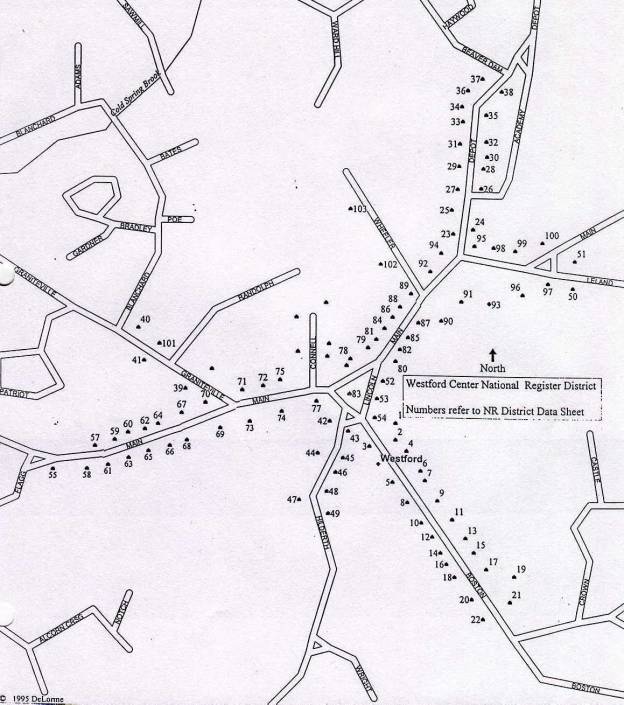
Westford Center Historic District was accepted for listing on the National Register on August 28, 1998, culminating work of the Westford Historical Commission going back to 1976. Copies of the complete nomination document, prepared by Sanford Johnson, Historic Preservation Consultant, and sponsored by the Westford Historical Commission, may be found in the J. V. Fletcher Library and at Westford Town Hall. Following is an abstract from that document. The original document contains more detailed information on the architectural characteristics of individual buildings.
Westford Center is the residential and civic center of the town of Westford, Massachusetts. Architectural resources consist of moderately to well preserved institutional, residential and commercial properties constructed from the Colonial to the Early Modern Periods. The historic district is comprised mainly of residential buildings and contains a church, historic former parish hall, library, town hall, police/fire station, museum, the town common, and three commercial structures. One hundred three buildings comprise the district. Of these, ninety-four are contributing elements and continue to associate the district with its historic trends of development. The historic appearance of these buildings is enhanced by the presence of many historic outbuildings, stone walls and gateposts. Architectural styles include Colonial, Georgian, Federal, Greek Revival, Italianate, Second Empire, Stick, Queen Anne, Shingle, Richardsonian Romanesque, Colonial Revival, Craftsman Bungalow, and English Revival. In addition to the architectural resources, there are numerous outbuildings, twenty structures, three sites and seven objects. The boundaries are defined by changes in density of historic buildings and by topographic changes.
Westford Center is located on Tadmuck Hill, which is the town’s highest eminence at 460 feet above sea level and marks the approximate middle of the town. It is located in the coastal lowland region of Massachusetts approximately ten miles south of the border of New Hampshire and approximately thirty miles northwest of Boston. The town is bordered on the east by Chelmsford, on the south by Acton and Carlisle, on the west by Groton and Littleton and on the north by Tyngsborough. The area of the town is approximately thirty-one square miles. Many of the geologic formations in Westford are glacial in origin, including Tadmuck Hill.
The setting of the Center residential district consists of open fields formerly used for agriculture mixed with forested areas. Building lots are between approximately one-quarter and seven acres in size with most buildings located within fifty feet of roads. Moderately dense residential development lends the district a village appearance. The generally well maintained buildings are residential in scale and predominately wood in construction. Landscaping is generally traditional with well-maintained foundation plantings and ornamental trees appearing throughout the district. It is distinguished from other parts of town by its elevated location on Tadmuck Hill, density of construction, quality of architectural design, average higher age of buildings, their stylistic pretension, and it is the site of most civic activities and the town common. It is possible to view parts of New Hampshire, Worcester County and the City of Boston, all at least ten miles from Westford Center. The district retains integrity of location, design, setting, materials, workmanship, feeling and association.
Westford Center began as a farming neighborhood in the 1720s when settlers, mainly from Chelmsford, built homes on Tadmuck Hill. In 1727, a church was established and the militia began training nearby. Land in the area was used mostly for residential and agricultural purposes through the eighteenth century, but the central location fostered construction of buildings for local government functions and other civic buildings such as churches and schools. Land use began to shift toward public functions after the initial First Parish Church building was constructed in 1727. The two uses coexisted for many years until the demise of the profitability of farming drastically curtailed agricultural land use in the mid twentieth century.
Many residences are located in the Center and were constructed by community leaders. For example, the manufacturer Allen Cameron occupied the house most recently used as a nursing home at 39 Main Street in the mid to late 1800s. Members of the Abbot Family lived in the House at 24 Main Street in the early 1800s. The Abbots were owners of the Abbot Worsted Company, employers of hundreds of Westford residents from 1878 to 1958. J. Henry Read lived at 30 Main Street ca. 1875. He was a prominent resident who served in town and state government in the late nineteenth century. 56 Main Street Ca. 1875 was the home of John Lanktree, tax collector, blacksmith and farmer during the late nineteenth century.
Many civic activities took place in the Center since its development as the core area of population. The earliest was the practice of religion at the First Parish Church, which is located to the north of Main Street. Services were first held on the site in 1727 and continue today in a building constructed in 1794, which stands just east of the site of the original structure. This building was reoriented in the late 1860s to face the common. The Westford Academy was established in 1793 and its building was located on Boston Road across from the Common. It was moved behind the Congregational church on Boston Road in the early twentieth century and served as a firehouse. It is currently used as a museum. The former Congregational Church separated from the First Parish Church in 1826 and constructed its own building in 1829 at the corner of Lincoln Street and Boston Road. This church was remodeled in 1896. It served as a church until the mid-twentieth century and parish hall for the First Parish Church until 1996. The Town Hall was built in 1870 and became the focus of town politics and continues to serve that purpose today. The J. V. Fletcher Library was built in 1895-1896 after the Town Hall was deemed too small to house the growing collection. It was enlarged in the early 1990s and still serves as the town public library. The trustees of Westford Academy constructed a second building to house the students in 1897. This was known as the Roudenbush School by the 1950s when it became a grade school and a new academy was built. It is now the Roudenbush Community Center. The W. E. Frost School was built in 1908 and served as a grade school until the 1980s. It is currently the Roudenbush Children’s Center at Frost.
Westford Center was also the site of some commercial activity. The earliest appears to have been a store established in 1762 on the north side of Main Street, west of the First Parish Church. The store is no longer standing. Other enterprises would follow, one of which was the Wright and Fletcher Store. This was housed in the building at 40 Main Street, which was built ca. 1840 and functioned until at least the early twentieth century. It is currently an art gallery. Another member of the Fletcher family ran a store at 6-8 Lincoln Street built ca. 1840, remodeled ca. 1905, which also stayed in business from the 1850s into the twentieth century.
The neighborhood of Westford Center surrounds the Common, which was sold to the town by Joseph Underwood in 1748 for use as a military training ground. As this type of use became less frequent, the Common was adapted to a park area for the residents and was used for Memorial Day and other civic celebrations. War veterans are memorialized here through statues, plaques and markers. Markers were placed here as early as 1899 when the cannon at the east end was installed. Other monuments followed. There is a bronze eagle commemorating war dead, water troughs of iron and granite and a stone monument to Col. John Robinson, Revolutionary War Veteran. There was a bandstand on the Common from the 1860s until around 1900. During this period, the Common was the site of civic celebrations on Memorial Day and to dedicate the library, the Civil War Memorial and other improvements. It remains a cultural and civic point of focus as well as a recreational resource. Attempts to improve landscaping were made in the nineteenth century by planting trees in a double row along the perimeter of the Common. Other improvements were made around 1919 when landscape architect Bremer Pond was contracted to design a more formal common green. This resulted in curbing at the edges, leveling and planting grass.
The majority of the remaining structures in the Center are residential and were constructed from the Colonial to the Early Modern period. Some modern construction is found on Main Street, Boston Road, and in five subdivisions around the Center. The modern construction is consistent with historic residential construction in terms of scale, materials and style. Current residents tend to work as professionals, and agricultural land use has been relegated to outlying areas of the town.
The Common is a level triangular piece of ground originally used as a military training field that now serves as a park and is the site of monuments, statues and a flagpole. It is bounded on the east by Lincoln Street, the northwest by Main Street and the southwest by Boston Road. It occupies approximately one acre and is planted with grass, tress and shrubs. Markers were placed here as early as 1899 when the cannon at the east end was installed. Other monuments followed. There is a bronze eagle commemorating war dead, water troughs of iron and granite and a stone monument to Col. John Robinson, Revolutionary War Veteran. There was a bandstand on the Common from the 1860s until around 1900. During this period, the Common was the site of civic celebrations on Memorial Day and to dedicate the library, the Civil War Memorial and other improvements. The Common is currently used as a recreational area.
The Whitney Playground, established 1910, is located in Westford Center between William E. Frost School and the Roudenbush School. It is a hilltop site with a view to the south. Structures on the playground include ballfields, children’s playground structures, tennis courts and maintenance sheds. A random ashlar granite block retaining wall approximately five feet in height separates the Roudenbush building from the playground. A row of lilacs is adjacent to the south portion of the wall. The location of the playground between the two former schools is indicative of the original use of the parcel, which was to accommodate outdoor activities of residents.
The oldest public building in Westford Center is the first Westford Academy building, constructed in 1793, which now houses the Westford Museum. It is a Georgian building with a rectangular two-story form of three bays’ width and six bays’ depth. It is a wood-frame structure with a wood shingle roof, wood clapboard siding and a cut granite foundation. The ridge-hip roof has at its center an octagonal belfry with an ogee-form copper roof and weathervane. A hip roof center entry porch with Classical details is attached to the façade. Windows are 12/12 double-hung sashes with molded trim and hoods at the first story. The entry is simply trimmed and has transom lights above. A single brick chimney is in the rear of the roof. Georgian ornament includes the eight arches with wood keystone details supporting the belfry, the balustrade and Classical cornice with dentils surrounding the belfry base, Classical cornice with dentils at the eave of the building, Classical trim on the entry porch which consists of a denticulated entablature and Corinthian columns and wood corner quoins. A gazebo of twentieth century construction housing a commemorative bell is north of the museum. The building has been restored to its 1793 appearance. The restoration was a gradual process over the last twenty years for use as a historical museum. It was moved from a site 1/10 mile to the east in 1910 by the town for use as a fire station. A gazebo of twentieth century construction housing a commemorative bell is north of the museum. It is in good condition.
A year after the construction of the Academy, the third building to house Westford’s First Parish Church was erected at 48 Main Street. It is a Georgian style wood frame, three by four bay, front-gable structure of two stories with a three-story tower attached to the façade. The roof is clad in asphalt shingles, the walls in wood clapboard and the foundation is built of cut granite. The tower is a square form in the center of the façade which contains the front double leaf entry at ground level, a six pane, fixed sash above and two 6/3 double-hung sashes above that. A clock is between the top window and the belfry. An octagonal belfry with dentils around the base and eight segmental arches with keystones rests atop the tower. The belfry is capped by a pointed, shingled rook with weathervane. Windows on the second story of the main block of the church are 9/9 double-hung sashes placed immediately below the eave. Those on the first story are 6/6 double-hung sashes and have hipped hoods. The façade is lit by two 6/6 double-hung windows on the second story. The center entry is lit by a large fanlight and is protected by a gable roof entry porch. An interior brick chimney is near the rear of the building. Decorative elements include the dentils in the gable peak of the entry porch, modillions at the building eaves, gable returns, molded cornices and a gold weathervane with a banner and arrow design on top of the spire. The immediately adjacent Parish Hall was built in 1996 and encroaches deeply upon the front yard of the church. First Parish Church is Westford’s most historically significant architectural resource.
A schism within the First Parish Church resulted in the construction of the former Congregational Church in 1829 (remodeled in 1896, formerly the parish hall serving the First Parish Church from the 1950s until 1996). It is a two story, wood-frame building built in the Late Victorian style. The main block is a rectangular front-gable form of three by three bays. Side ells are attached to the east and west walls and a wide, square tower with pyramidal roof is located at the northwest corner. The roof is clad in asphalt shingles, the walls in wood clapboards and the foundation is built of cut granite. A variety of windows exists. The façade has a large paired round-headed stained glass window in the center with an oculus and round hood molding. Others on the façade are the shingle round-headed stained glass on the east side and a rectangular stained glass window with a round hood on the west side of the façade. Other walls exhibit similar arrangements of window types. The entry is recessed under a wood Romanesque arch. A stained glass transom light reads 1829-1896 and was probably installed at the time of remodeling in the latter year. A single brick chimney is near the rear of the church. Ornament consists of the Romanesque entry, the pyramidal tower, round hood moldings over stained glass windows. The Congregational Church was remodeled into a front-gable Late Victorian style building and retains its design association to this period. It is in good condition.
The end of the Early Industrial Period saw the construction of the Town Hall at 55 Main Street (1870). The building is a three by six bay, rectangular, two and one-half story front-gable form. It is a wood-frame structure with an asphalt shingle roof, wood clapboard siding and a cut granite foundation. A three-story tower with belfry is attached to the façade. The Town Hall is attached at the southwest corner to the Police/Fire Station, built in 1974. Windows are 6/6 double-hung sash with segmental arch hoods at the first floor and flat hoods at the second story. Windows on the façade are paired sashes with double segmental arch hoods. The front entry is in the base of the tower and is covered by a flat roof porch with balustrade above and Colonial Revival columns at the sides. A brick chimney is at the northwest corner of the roof. Ornamental elements include a wide frieze, brackets at the eaves on the rear of the building and an oculus on the second story of the front of the tower. The building was enlarged by one bay at the rear in the late nineteenth century. The original Second Empire tower was destroyed in the 1938 hurricane and the present Colonial Revival tower with a domed roof belfry was added at that time. The Town Hall is in excellent condition.
In 1875 the town contracted for the construction of a new District #1 school at 20 Boston Road. It is a Second Empire design two stories in height, three bays in width and three bays deep. A Mansard roof is the dominant design characteristic of the structure. Pedimented dormers are found in the secondary slope of the roof and a brick chimney is at the center. A center gable dormer is above the entry hood, which is in the center of the first story. Windows on the first floor have projecting hood moldings but otherwise the surrounds are fairly simple. Second floor windows are inset dormers and have pilasters at the sides and stylized Classical ornament at the hood. A frieze board and paired brackets are located at the eaves. A decorative shield is situated in the middle of the gable dormer on the second story of the façade. The entry is protected by an ornate flat roof entry hood with paired brackets at the cornice and curvilinear brackets at the sides. The building was adapted for use as a residence in 1995 and retains its Second Empire design features.
Trends in philanthropy at the close of the nineteenth century led to the construction of the J. V. Fletcher Library at 50 Main Street in 1895. It is a three bay Late Victorian design executed by architect H. M. Francis, primarily in stone and buff colored brick. It is a two-story, three-bay, ridge-hip roof structure with a projecting central bay surmounted by a closed gable. Gabled dormers are located on each side slope of the roof. The roof is clad in slate and the walls are built of buff colored brick. The building rests on an elevated foundation of cut granite and rubble stone construction. Wall trim consists of a cut stone string course between the floors, wide cut stone eave trim and a copper cornice ornamented with an egg and dart pattern. First floor windows are trimmed with flat arches of brick. The recessed entry is ornamented with a terra cotta and cut granite block surround marked with the date 1895, a keystone atop the arch, and Arts and Crafts style floral motif. Brick chimneys with corbel caps are located at each side slope of the roof. An early 1990’s addition consists of matching two story wings of buff colored brick and little other ornament. The wings approximately double the size of the structure and maintain the character of design established by the original. They are two bays in width and two stories tall. The only ornament is a beltcourse of soldier bricks between the floors. Windows and eaves are unornamented. The library is the only building in the Center built completely of brick. It is comparable to no other structure in town in terms of design and is one of the most valuable architectural assets of the town of Westford.
Immediately after the library was built with privately donated funds, the town saw fit to erect the building at 65 Main Street, which is the exuberant Late Victorian style Roudenbush School. It replaced the 1793 Westford Academy building in 1897 and served that function until 1955. It currently serves as a community center. The richly ornamented wood-frame building is a rectangular, three by seven bay, two and one-half story form with a hip roof and projecting central gable. A one story Colonial Revival ell is attached at the rear and houses a gymnasium. The roof is clad in slate shingles, the walls primarily in wood shingles, and the foundation is build of random coursed granite ashlar. Secondary gable roof entry porches give access to the basement level on the east and west sides. A variety of windows exists on the building. The peak of the projecting central gable is lit by three round-head, four-pane ribbon windows that are divided by colonettes. The frieze has five fixed sash of eight panes in the projecting gable and one on each side of the main block of the building. Immediately below the sash in the frieze are five 4/1 double-hung sash in the projecting gable and 6/1 double-hung sash on the main block. The first story is lit with a 6/1 double-hung sash on both sides of the main block. Large multiple pane sash with Romanesque hood moldings are located between floors on the east and west sides. A Richardsonian Romanesque arch built of wood that is cut to resemble stone vussoirs marks the recessed center entry on the first story of the projecting gable. The double leaf entry has a wide flanking band of fixed sashes and transom lights. A metal chimney and two hip roof dormers are on each side of the hip roof. Dormers are lit with 6/1 double-hung sash and are clad in slate shingles with copper flashing on the roof and wood shingles on the cheeks. A belfry occupies the peak of the hip roof. It rests on a square base and is supported by a round pinnacle at each corner. The domed copper roof is capped by a small spire with weathervane. The Roudenbush School has the widest array of ornament in the town of Westford. The belfry is articulated with a short, trabeated colonnade above an arch at each of its four sides. The pinnacles are capped with copper finials and grotesques. The spire atop the belfry has colonettes supporting a slender pyramidal roof. The eaves of the building have modillions above a shingled frieze and a row of dentils. The walls above the water table are clad in a wide band of beaded flushboard siding. The entry arch has dentils at the extrados, egg and dart molding at the intrados and rosettes at the springing line. Basement level entry porches have gable roofs supported by grouped colonettes and pilasters that rest on random coursed granite ashlar knee walls. The peaks of the gables are enclosed with wood screens. Classical molding and gable returns further articulate the porches. The building was enlarged at the rear in approximately 1930 with a one story gymnasium that is fenestrated with round head windows with Colonial Revival molding and keystones. The building is in excellent condition and retains its original design intent.
Late Industrial Period public building culminated in construction of the Frost School in 1908, which was intended to house the conglomerated school districts. Designed by Carl V. Badger, 73 Main Street is a two story, three by five bay Colonial Revival structure with a ridge-hip roof. It is a rectangular building with a projecting central bay on the façade. Entries flank the bay and are protected by flat roof, one-story porches with full entablatures at the cornice. The porches are supported by grouped columns at the corners, which rest on plinth blocks. A one-story, three-sided bay window is at the center of the first floor of the façade. A pedimented dormer is located on the front slope of the roof. The structure is clad in wood clapboard, the roof is sheathed in slate and copper and the foundation is built of cut granite. Eaves are deep and have wide frieze boards. Walls are trimmed with spandrel panels below the two story compass windows at each side of the projecting bay and slim pilasters are at the corners of the building. The compass windows are surrounded by classical trim with keystones at the top. Other windows are 6/6 double-hung sash with plain surrounds. Entries are located under the side porches and have plain surrounds. An interior brick chimney is at the center ridge of the roof and two metal ventilators are at the rear slope of the roof. Two prefabricated tool sheds, a fence, and a playground are adjacent to the building. Other period school buildings include the 1897 Roudenbush School, which is larger and designed in a more ornate Victorian Eclectic style.
A modern civic building constructed in approximately 1974 at the north end of the Common houses the Police and Fire Departments (non-contributing). 51-53 Main Street houses firefighting apparatus in the two-story front-gable structure comprising the west side of the building and police functions in the east-side one-story ell. The late twentieth century structure is clad in wood clapboard and has a concrete foundation. Shed roof towers mark the roofline at the east and west slopes of the front-gable roof. Ornament consists of the lunette in the peak of the gable over the metal roll-up doors that admit fire vehicles. The building is in good condition.
The oldest surviving commercial building in Westford Center is the former Fletcher Store, built ca. 1840, at 40 Main Street, which is a combination of residential and commercial space. The two and one-half story, front-gable main block is joined at the rear of the west wall to a large two-story side-gable ell that forms an L-shaped plan. The front-gable façade is two bays across with each bay containing two windows at the second floor and a projecting bay window at the first. The bay windows at the façade are intended to display commercial goods and are connected above by a hip roof, which forms a recessed center entry. A small two-story ell is located at the intersection of the two rectangular blocks of the building. It is lit on the south side by a roundel and on the west side by a 6/6 double-hung sash, both at the second story. An unornamented entry is on the south side of the first floor of the ell. The larger two-story ell has a second story flat roof porch on the front with a screened knee wall and carved brackets and posts. Diagonal knee braces support the porch from below. Windows are generally 6/6 double-hung sashes except the roundel and the large fixed panes in the bays. The center entry is unornamented. There are two interior brick chimneys and a modern skylight in the roof. Much original ornament has been removed although the closed gable remains.
The most prominent commercial building faces the south side of the Common. 6-8 Lincoln Street, ca. 1840, remodeled ca. 1905, is an accreted, wood-frame, two and one-half story Queen Anne style building with a complex plan that contains several dwelling units and professional offices. The building was formerly a store and residential/commercial structure that was enlarged at the start of the twentieth century with a wide porch on the façade and an octagonal tower on the east side of the façade. It is seven bays wide and four bays deep. The roof is clad in slate shingles, the walls in wood clapboards and the foundation is built of cut granite and cast block under the tower and porch. A ¾-width, one-story shed roof porch is attached to the façade between the tower and the gable-front block. A second shed roof porch is at the rear of the residential section of the building. Windows are 2/2 double-hung sashes except at the roof level of the tower, which is lit by short 6/1 double-hung sashes. The center entry is a double leaf arrangement located under the low pedimented gable on the front porch. A second entry is recessed into the canted west corner of the building. Two interior brick chimneys are near the rear of the building. A single gable dormer is located on the front slope of the side-gable block and is lit by a Palladian window. Decorative elements consist of the wide cornice and frieze, corner pilasters, eave brackets, short gable returns, a spindle frieze, turned posts, carved brackets and Arts and Crafts ornament on the front porch. The building retains most of its historical fabric and its associations with nineteenth century residential/commercial architecture. It is in good condition.
Two Early Modern Period commercial buildings exist in the district. 2 Depot Street, ca. 1945, is a Colonial Revival style building in use as a telephone service facility. The rectangular six by one bay brick structure is one story high and has a large brick addition attached to the rear. The side-gable roof is clad in asphalt shingles, the walls are brick and the foundation is concrete. Windows are 6/6 double-hung sashes trimmed with brick flat arches and sills. The front entry is trimmed with a Colonial Revival surround. A single brick chimney with a copper cap marks the roofline. Decorative elements include gable returns and a molded cornice. The addition in the rear is also a brick side-gable structure and is connected by a small ell. 45 Main Street, ca. 1930, is the former post office and has been converted for use as a bank. The Colonial Revival brick structure is a one story, side gable, rectangular form with a flat-roof rear ell. It is five bays wide by four bays deep. Windows are 6/9 double-hung sashes with brick sills, shutters and no other trim. The center entry is trimmed in Classical molding with a transom above. An ornamental ventilator with louvered vents and a pyramidal roof occupies the middle of the ridgeline. Other ornament consists of a frieze that acts as a signboard, brick quoins and gable returns. A chain link fence separates the property from its neighbor to the west. The front, rear and west side yards are paved for parking.
Few Colonial Period residences survive in the district. Most houses constructed before 1775 have either been lost to fire, moved out of the district or subsumed under later construction and are no longer recognizable as Colonial buildings. A visible example is at 3 Depot Street, built in approximately 1730. It is a two and one-half story, side-gable, three by two bay residence with a one and one-half story ell on the south side wall connecting to a barn at the rear. A pedimented porch projects from the façade over the center entry. It is sided with wood clapboards and the roof is covered in asphalt shingles. The foundation is cut granite. The vernacular building is nearly devoid of ornament. A slim plain return marks the eaveline on the gable end. Narrow corner boards and a plain cornice constitute the remainder of the trim. Windows are primarily 6/9 double-hung sash with 6/6 double-hung units and a fixed six-pane sash in the ell. Sidelights, pilasters and columns flank the entry. The barn is an attached, side-gable structure, one and one-half stories in height with two vehicle entries. Windows on the façade are six-pane fixed sash. The roof is asphalt shingle, the siding is wood clapboard and the foundation is rubblestone. An ell is attached at the rear. 3 Depot Street is an early structure in Westford Center that retains integrity of design, location and association.
Another significant Colonial house is 2 Hildreth Street, ca. 1713, the oldest building in the district. This is a two and one-half story, side-gable, five bay Colonial style residence. Ells are located at the south side and at the rear of the building. It is a wood-frame structure clad in wood clapboard with a slate roof. Ornament is limited to the entry surround, which is articulated by full-length sidelights and a simple molding. There is a one-story bay window at the rear of the house and a gable dormer on the roof of the side ell. Windows are 6/9 double-hung sash with simple trim. Two brick chimneys with corbel caps are located on the ridge of the main block of the building.
The third surviving Colonial residence is the Charles Fletcher House at 62 Main Street, 1740-1780. It is a two and one-half story, five bay, side-gable Colonial house. One-story ells are located at each side of the building and a one-story bay window is at the west side of the first floor. The roof is clad in asphalt shingles, the walls in wood clapboard, and the foundation is built of cut granite. The most prominent ornamental detail is the entry surround which is Federal in style. It consists of a denticulated cornice over a wide frieze board, Ionic pilasters at the sides, three quarter length sidelights and a fanlight above the door. Windows are 2/2 double-hung units with narrow, simple surrounds. Eaves have narrow trim boards and short gable returns. The five-sided bay window at the west wall is capped by a cornice and frieze board and has quarrel panes set in double-hung sash. Two brick chimneys rise from the ridge of the side gable roof. The significance of the Fletcher House lies in its design integrity and in its well-maintained condition.
A great deal of development took place in Westford Center during the Federal Period and many residences survive to illustrate the methods of construction and design choices that residents made during the period. While few houses exhibit high style Federal form, several retain a moderate level of detail and association with the design concepts of the period.
1 Hildreth Street, ca. 1780, remodeled 1846, is a two and one-half story, five bay, side-gable residence. The ell to the rear of the main block of the house was built in 1790. The more formal Federal style front section was constructed in 1846. It is a wood-frame building constructed on a cut granite foundation with an asphalt shingle roof and wood clapboard siding. Eaves are articulated with a frieze board, 6/6 façade windows with wide surrounds, and the recessed entry is flanked by sidelights and surmounted by a transom. The sidewalls are marked by full gable returns. The barn at the rear is a one and one-half story, two bay, side-gable structure sided with wood clapboards. There are two vehicle entries and a gable dormer on the façade. 1 Hildreth Street is similar in scale and design to 72 Main Street and presents a well-maintained façade to the Common and to the Civil War Memorial.
7 Hildreth Street, ca. 1830, is a rectangular Federal style dwelling. It is a side-gable, two and one-half story, five by two bay, wood-frame building with an asphalt shingle roof, wood clapboard siding and a cut granite foundation. An attached shed and two bay garage are at the rear of the house. Windows are 12/12 double-hung sash with molded surrounds and shutters. A square bay window with a wood shingled hip roof and a multiple-pane picture window occupies the south side of the first story. The center entry is a high style Federal design with full entablature, dentils, pilasters and sidelights. The fanlight depicts an eagle rendered in leaded art glass. Brick chimneys are at the north side and in the center of the roofline. Other ornament includes slim corner boards and cornice and a water table. The attached barn is a front-gable, two-story, two bay structure converted for use as a garage. A cut granite and uncut granite wall separates the front yard from the street. The house is unaltered except for the bay window and is in good condition.
4 Leland Road, ca. 1794, is a two and one-half story, six bay, side-gable, Federal style with two ells at the rear. Walls are clad in wood clapboard, the roof in asphalt shingles and the foundation is built of cut granite. Two brick chimneys rise from the main part of the roof and a third chimney is located in the first ell. A large porch with a rounded corner pavilion extends from the façade around to the eastern side of the house. A carriage porch surmounted by a balustrade and an enclosed porch projects from the front of the building, covering a portion of the driveway. The large porch and carriage porch are of Colonial Revival design and were added well after the original section of the building was completed. A second, smaller porch is located at the west side of the first rear ell. Ornament on the earlier portions of the house is restrained. Windows are 6/6 double-hung sash with simple surrounds. The main entry appears to have been remodeled around the time the porches were added. It is surrounded by simple bead moldings with circular bosses at the corners. Eave trim is minimal. The barns are located close behind the house. The closer of the two is a large side-gable form oriented parallel to the main block of the house. The second barn is smaller and is oriented in the same direction. Both are clad in clapboard and have granite foundations. Wide stone walls surround the property. 4 Leland Road has the most ornate porch example and one of the few carriage porches in Westford.
24 Main Street, ca. 1820, is the most formal Federal style house in the district. It is three stories in height, five bays in width and four in depth. The roof is a ridge-hip form with two chimneys at each side. An ell is located on the west wall, connecting the house to the barn. A hip roof, one-story porch projects from the façade over the center entry. The main exterior materials are wood clapboard on the façade and brick on the sidewalls. The roof is sheathed in asphalt. Federal style ornament is seen in the dentils at the eaves, the simple hood moldings over the 12/12 double-hung sash, the Doric pilasters at the corners of the main block of the building, and in the Classical lines of the entry porch, which is supported by Doric columns at the corners. The symmetry of the façade and the reduction in size of the third floor façade windows to 8/12 panes are the most characteristic Federal elements. This is the purest example of Federal design in Westford and makes a major aesthetic contribution to the center of the town. The attached ban is a front-gable, one and one-half story clapboard structure with a central vehicle entry. There is a roundel in the façade gable peak and other secondary openings placed across the façade. A square ventilator with louvered vents, bracketed eaves and a weathervane is located at the middle of the roof peak.
Residential development during the Federal Period continues to lend the district much of its character and sense of place, but a large number of buildings also survive from the Early Industrial Period. These contribute to the historical associations embodied in Westford Center due to their number, quality of design and high degree of preservation. Several of the Early Industrial Period houses exhibit Federal style elements from the mid nineteenth century. Others have Greek Revival elements and still others have few or no distinct stylistic elements.
24 Boston Road, 1843, is a five by one bay, two and one-half story, side-gable residence with some elements of the Federal style. There is a large ell that connects the main block of the house to the barn at the rear. A shed roof porch of one story is attached at the south side of the ell. A secondary one-story ell projects from the north wall of the house. The house is clad in wood clapboard, the roof is sheathed in asphalt and the foundation is built of cut granite. Ornamental elements are found at the entry, which has a wide surround, ¾ sidelights and transom lights. Windows are 6/6 double-hung sash and the surrounds are narrow and simple. The long ell at the rear is oriented perpendicular to the main block of the house and is lit by a variety of sash types. The porch is supported by three paired posts and extends slightly more than half the distance to the barn at the rear. The front-gable one and one-half story barn has a single vehicle opening and a double-hung window in the peak. It is clad in wood clapboard, the roof in asphalt and the foundation is built of cut and uncut granite. A wellhouse is located in the dooryard. 24 Boston Road is a typical local example of the Federal style. It is well maintained and comparable in scale and design to others in town such as 36 Main Street.
25 Boston Road, ca. 1840, is a wood-frame dwelling with Federal style elements located in the Westford Center residential district. The plan is a rectangular, three by two bay, two story form with a two story rear ell. The roof is clad in asphalt shingles, the walls in wood clapboard and the foundation is built of cut granite. The side-gable roof is marked by two side chimneys and a widow’s walk. A rear one-story shed porch is on the south side of the rear ell. Windows are 6/6 double-hung sashes with tall hood moldings and shutters. The center entry is lit by side and transom lights and has a hood supported by carved brackets. The chimneys are ornamented with corbel caps and the widow’s walk has a plain balustrade and an oculus in the base. An attached shed was built onto the rear of the building in the late twentieth century. A post and rail fence and a stone wall are in the front and side yards.
5 Depot Street, ca. 1840, is another wood-frame dwelling with Federal elements built in the early Industrial Period. It is a rectangular, five by one bay, two and one-half story house with a one and one-half story side ell. The side-gable roof is clad in asphalt shingles, the walls in wood clapboard and the foundation is built of cut granite. Windows are 6/6 double-hung units with simple trim. The entry has wide trim and ½-length sidelights. A single center brick chimney is in the roof of the ell. A secondary entry is in the side ell and is covered by a hip roof hood with ornamental brackets. Ornament on the main block of the house consists of corner pilasters and a frieze at the eave. A two-bay barn is attached to the side ell. The house is in good condition.
20 Depot Street, ca. 1840, is a wood-frame dwelling with Federal style ornament. It is a side-gable, five by two bay, rectangular building of two and one-half stories with a one-story south side ell. The roof is clad in asphalt shingles, the walls in wood clapboards and the foundation is built of cut granite. The center entry porch has a pedimented roof with two Doric columns at each corner. Windows are 6/6 double-hung sashes with hood moldings and shutters. Pilasters and 2/3 length sidelights flank the front entry. A single center brick chimney marks the roofline. Decorative elements consist of a wide frieze, corner pilasters, gable returns and Colonial Revival cornice and columns on the entry porch. A detached two bay, two-story, front-gable wood-frame barn adapted for use as a garage is in the rear yard. A deck has been added to the rear of the house. Ornamental cut granite posts line the border of the front yard. The house retains much of its original fabric and design intent and is in good condition.
4 Lincoln Street, ca 1843, is a two and one-half story, five bay residence with elements of the Greek Revival style. An ell attaches the house to the large barn at the rear. The side-gable roof is clad in asphalt shingles, the walls in wood clapboard and the foundation is constructed of cut granite. Federal elements are seen in the wide eave boards and paneled pilasters. Greek Revival influence is seen in the closed gables. Relatively plain window hood moldings surmount the 6/6 double-hung sash. A one-story bay window projects from the west side of the first floor. The recessed entry is lit by sidelights and a transom and is surrounded by a wide, flat molding with a slightly projecting hood. Two brick chimneys with restrained corbel caps rise from the roof of the main block of the house. The setting is unique in Westford in that it is a residence that faces the Common across the street. The barn is a one and one-half story, front-gable form with a double vehicle entry at the façade. It is clad in wood clapboard. An ornamental lunette in the peak lights the interior of the second floor.
21 Main Street, ca. 1835, is a five bay, two-story house with Federal style elements and a two-story Colonial Revival addition at the east wall. The roof is a ridge-hip form over the Federal block and flat over the addition. An attached barn is located at the rear of the east wall. The house is constructed of wood and clad in clapboard. The roof is clad in slate and copper and the foundation is built of cut granite. Federal style ornament includes a center entry with a wide Classical surround and round arched fanlight, pilasters at the corners of the main block and spandrel panels built of wood flushboard between the first and second story façade windows. Colonial Revival elements are seen in the balustrade atop the wing and the semicircular hood moldings over the first floor windows. Windows are primarily 8/12 double-hung sashes. The house is more ornate than most other Federal designs in town. The attached barn is at the rear of the Colonial Revival addition. It is a front-gable, two and one-half story structure with two vehicle openings on the façade, one being located in a shed roof addition at the east side of the barn. It is ornamented with a roundel in the gable peak and a square ventilator at the peak of the roof. The ventilator has a pyramidal hip roof and paired louvered vents at the sides.
25 Main Street, ca. 1850, is another dwelling with Federal style elements. It is a rectangular, two and one-half story, five by two bay house. The side-gable, wood-frame structure is clad in wood clapboard with an asphalt shingle roof. A two-story ell is attached to the rear of the main block of the house. Windows are 6/6 double-hung sashes with slim hood moldings and shutters. The center entry is trimmed with a wide surround. There are three interior brick chimneys. Ornament consists mainly of the wide Federal style entry surround with sidelights. A secondary entrance with hood and carved brackets is located on the south side of the house. A detached side-gable two bay garage with cupola is in the rear yard. It is a wood-frame building constructed with elements of the Colonial Revival style.
Other Early Industrial Period houses in the district have Greek Revival elements although they are fewer in number than other styles. 14 Boston Road, ca. 1830, is a wood-frame Greek Revival dwelling in the Westford Center residential district. It is a front-gable, two and one-half story, three by four bay form with a one-story side ell on the south side. The roof is clad in asphalt shingles, the walls in wood clapboard and the foundation is built of cut granite and brick. A one –story porch is located on the south side near the junction of the ell. Windows are 6/6 double-hung sashes with simple trim and shutters. The side hall entry is trimmed with pilasters, a wide frieze with cornice and sidelights. A single interior brick chimney marks the roofline. Decorative elements consist of a closed gable, corner pilasters, a wide frieze and a molded cornice. A detached two-story front-gable barn is in the south side yard and has vertical flushboard siding. Openings on the façade include a large vehicle door, a double-hung sash and double leaf doors in the gable peak. A low cut granite wall separates the front yard from the street. The house and barn in the south yard retain much of their original fabric. The house is in good condition and the barn is in fair condition.
8 Depot Street, ca. 1835, is a wood-frame Greek Revival dwelling located in the Westford Center residential district. The house is a rectangular, front-gable, one and one-half story arrangement with a one story rear ell. The main block of the house is three by two bays. The roof is clad in asphalt shingles, the walls in vinyl clapboard and the foundation is built of cut granite. Windows are 6/6 double-hung sashes with no trim. The side hall entry is flanked by 2/3 length sidelights and is covered by a trellis with a segmental arched roof. A center brick chimney and a gable dormer are on the north slope of the roof. Decorative elements consist of gable returns on the façade, a wide frieze and a molded cornice. An attached two bay, front-gable garage is in the rear yard. The house has been altered with the addition of vinyl siding and replacement windows and is in good condition.
78 Main Street, ca. 1850, is a three bay, front-gable, Greek Revival house built on a side hall plan. The house is rectangular with a one-story ell at the rear. Shed dormers are located on each slope of the roof. The house is sided with wood clapboards, the roof is sheathed in asphalt shingles and the foundation is built of cut granite. Eaves are articulated with heavy moldings and wide frieze boards characteristic of the style. Corner boards are paneled pilasters with molded capitals. Windows are 2/2 double-hung sash and have plain surrounds. The recessed side hall entry is lit with full-length sidelights and surrounded with wide trim. A stone wall separates the house from Main Street and a two-story, gable front barn sided in wood clapboards is in the back yard. 78 Main Street is a well-maintained example of a one and one-half story Greek Revival residence in Westford Center.
80 Main Street, ca. 1850, is a small Greek Revival wood-frame residence. It is a rectangular front-gable banked building of two and one-half stories at the façade and one and one-half stories at the northwest and rear. The façade is three bays at the first story and one bay at the second. The house is three bays deep and has a one and one-half story side-gable ell at the southwest side. It has an asphalt shingle roof, wood clapboard siding and a cut granite foundation. Windows are 2/2 sashes with molded surrounds and shutters. Small frieze windows light the second story of the side ell. A trellis with a segmental arch hood covers the front entry. A more formal entry is located on the northwest side and has sidelights and pilasters in the surround. A single center brick chimney with corbel marks the roofline. Greek Revival ornament includes the molded cornice, corner pilasters, a closed gable on the façade, and a wide frieze. A detached side-gable, wood-frame shed is in the south side yard. A four-foot high wall separates the front yard from the street. The house appears to retain integrity of materials and is in good condition.
There are residences in the historic district that exhibit Greek Revival elements but have been altered with eclectic nineteenth or early twentieth century additions. 1 Leland Road, built in 1846 and remodeled ca. 1910, is a two and one-half story, three bay, front-gable residence with prominent elements of the Greek and Colonial Revivals. There are several ells to the rear that connect the house to sheds and a barn. A second barn is detached from the residence. A large Classical Revival porch dominates the façade at the first floor level. It is supported by seven Doric columns and has a balustrade with urns atop the railing at the second floor level. The roof is sheathed in asphalt shingles, the walls in wood clapboard and the foundation is built of cut granite. Windows are mainly 8/8 double-hung sashes, with the exception of the oculus in the side ell and the 6/6 window in the peak. Greek Revival elements include wide eave boards, pilasters at the corners and a side hall plan. Colonial and Classical Revival elements are seen in the porch and balustrade, broken arch pediment above the peak window of the façade, the oval oculus with keystones in the bay projecting to the north, and the two bay windows at the south side wall. Window surrounds are simple. The entry is flanked by sidelights. Two brick chimneys rise from the main block of the house and a third is located in the first ell to the rear. Two barns died in wood clapboards are in the side and rear yards. 1 Leland Road is a well-maintained and intact example of an Early Industrial Period house with Colonial Revival alterations.
37 Main Street, 1848, is a Greek Revival style, wood-frame dwelling modified with a Colonial Revival addition at the west side. It is a two and one-half story rectangular building. The main block is six by three bays clad in wood clapboard. A full-width one-story hip roof porch is attached to the façade and is supported by seven Doric columns and a wide frieze. A two-story ell was added to the west side of the house in 1914 and constitutes the sixth bay of the façade. A tripartite 6/6 sash with sidelights lights the center bay. The first floor of the façade is lit by 9/9 windows that are taller than those on the second floor. The center entry is surrounded by sidelights, transom lights and wide Classical trim. Two center brick chimneys with corbel caps mark the ridge of the roof. A balustraded captain’s walk occupies the ridge of the roof between the two chimneys. Ornament includes a wide frieze at the molded cornice, closed gables at the sides, the classically inspired porch cornice and columns, and wide corner boards on the main block of the house. A wood fence is attached at the west side. The porch and the west side ell were probably added around 1914. The house is in good condition.
The Symmes/Cameron House at 39 Main Street, ca. 1850, is a two and one-half story, five bay, side gable structure with elements of the Greek Revival and Victorian Eclectic styles. A detached barn is at the rear of the house. A one-story flat roofed porch stretches across the façade and the side elevations. One-story bay windows are located on the second floor of the east side and the façade, and a first floor bay is at the west side. A gable dormer is located over the center bay of the façade and a hexagonal widow’s walk with balustrade is at the peak of the roof. Siding is wood clapboard and the roof is clad in slate. The main block of the house was built in the Greek Revival style with wide frieze boards and paneled pilasters at the corners. Second floor windows are 2/2 double-hung sash with prominent hood moldings. Those on the first floor of the façade are full-length sashes flanking the entry, which is trimmed in classical molding. Pilasters are found on the first story of the façade underneath the porch. Details from the late Victorian Period take the form of eave brackets, one-story bay windows and the gable dormer with its oculus. Two brick chimneys with restrained corbel caps mark the roofline. The barn is a two and one-half story, three-bay, front-gable form with a single vehicle entry that has been converted to a doorway of human scale. The double-hung windows have hood moldings and the building is clad in clapboard. It appears to have been converted to domestic use. A metal ventilator is located at the center of the roof peak. A second outbuilding is located east of the barn and formerly served as a windmill. It is similar to a gazebo in form and scale with open sidewalls, a Mansard roof and an elevated floor. It is articulated with Stick style ornament. The former Cameron House is a significant Victorian Eclectic design and a substantial presence in the center of town. There are other houses built in this Eclectic style, but it is unmatched in terms of scale, proportion and setting.
Other houses were built in a more vernacular vein and illustrate fewer architectural details than those described above. 11 Boston Road, ca. 1860, is a wood-frame dwelling with no distinct architectural style. It is a rectangular, two-story, side-gable form of four by two bays. The building has a wood-frame, asphalt shingle roof, and a cut stone foundation. A two-story flat roof bay is attached to the north wall and a pedimented porch covers the center entry. Windows are 12/12 double-hung sashes on the second story and 2/2 units on the first. Beaded trim surrounds the windows and the front door. A side brick chimney is on the south wall. Ornamental elements include the Colonial Revival columns and cornice on the pedimented entry porch. A one-story, side-gable wood-frame barn is in the rear yard. The house retains much historic exterior fabric and is in good condition.
1 Main Street, ca. 1850, is a rectangular, two story, five by two bay, single unit residence at the corner of Flagg Road and Main Street, which is the west end of the historic district. The house has no distinct architectural style but retains visual associations with mid nineteenth century construction methods in its form and massing. It is a side-gable form with a projecting front-gable dormer and a side-gable, two-story ell attached at the rear of the main block of the house. A full-width, hip roof porch covers the first floor of the façade. It is a wood-frame structure with an asphalt shingle roof, wood clapboard siding and an uncut stone foundation. Ornament is limited to dentils at the eaves, which were probably added during a renovation project within the last ten years. Windows are typically 6/2 double-hung sashes with simple surrounds. Corner boards and trim at the entry is also plain. A brick chimney is attached at the south wall.
A variety of Late Industrial Period building styles is represented in Westford Center. The most common are the Late Victorian and the Colonial Revival. Others include the Second Empire, Shingle, Italianate and Queen Anne styles. Many houses exist that have no distinct style.
4 Boston Road, ca. 1870, is the Late Victorian former fire cottage and is now a meeting hall for staff of the adjacent Westford Museum, the Westford Historical Society, the Westford Historical Commission, and the Westford Academy Trustees. The wood-frame building is a rectangular front-gable form of one and one-half stories. It is two by three bays and has a rear ell of one story with an enclosed shed roof porch. The roof is clad in asphalt shingles, the walls in wood clapboard and the foundation is built of cut granite. A full-length one-story hip roof porch on the façade has a full entablature and covers a five-sided bay window and the side hall front entry. Windows are 2/2 double-hung sash with hood moldings. The front entry is ornamented with a wide surround. Two interior brick chimneys and a shed dormer occupy the roof. The rear chimney is capped with a pointed arch made of brick. Ornament consists of wide frieze boards and pronounced eaves, corner pilasters, jigsawn porch posts and brackets. The building is in good condition.
23 Boston Road, ca. 1885, is a Late Victorian style wood-frame dwelling. It is a three by two bay rectangular front-gable form of two and one-half stories. A two-story ell is attached to the rear wall. The roof is clad in asphalt shingles, the walls in wood clapboard and the foundation is built of cut granite. Windows are 2/2 double-hung units with hood moldings. The side-hall, double-leaf front door is covered by a hood with carved brackets. A single brick chimney is on the south side of the roof. Three-sided bay windows are located on the south side of the façade and the rear of the south elevation. Decorative elements consist of paired brackets at the eaves of the building and of the bay windows, a wide frieze, wood quoins, classical moldings and the entry hood and gable returns on the façade. The attached barn was removed in 1996 during renovation and replaced in 1997 with a compatible design. A tennis court is in the north side yard. The house is in good condition.
6 Depot Street, ca. 1870, is a Late Victorian, rectangular, wood-frame dwelling of two and one-half stories. The four by one bay, cross gable building has an asphalt shingle roof and wood clapboard siding. The main block of the house is a front-gable form with a side-gable ell of two stories attached at the south wall. A two-story, four-sided bay window occupies the middle of the façade. Windows are 6/6 double-hung sash with simple surrounds. The recessed side hall entry has sidelights, a pedimented hood and wide molded trim. A brick chimney is at the south side and two are in the center of the roof. Decorative elements consist of gable returns at the eaves, corner pilasters, a wide frieze and a molded cornice. A rear two-story ell connects the house to the two bay, front-gable barn. The one and one-half story, two by two bay wood-frame barn has a compass window in the gable peak and a molded cornice with gable returns. A post and rail fence is in the front yard and a stone wall is in the rear.
17 Depot Street, ca. 1880, is a wood-frame Late Victorian dwelling located with a two by two bay rectangular form that is two and one-half stories in height with a two-story ell at the rear. The cross gable roof is clad in asphalt shingles, the walls in wood clapboard and stagger-butt wood shingles and the foundation is built of cut granite. A one-story, hip roof porch is attached to the west and north walls. Windows are 2/2 double-hung units with plain trim. The front entry is also unornamented. A secondary entry is on the north wall of the rear ell and is covered by an ornamental shed roof hood. Second story bay windows are on the north and west walls. A brick chimney is in the center of the roof. Decorative elements consist of the exposed rafter ends at the eaves of the building and the second story bay windows, the Mansard roof above and consoles below the north wall bay, turned posts with carved brackets on the porch and patterned shingles at the mid-level of the walls. A two bay detached barn of one and one-half stories clad in wood shingles is in the rear yard. At the north corner of the yard is a stone marked with carved outlines of a ship and a sword which commemorate the presence of a Scottish exploration party who may have visited the site in the 14th century. It is protected by stone posts connected by a chain. The event and the marker are under historical investigation and their veracity remains in question. The house retains much of its original design intent and is in good condition.
8 Graniteville Road, ca. 1880, is a two and one-half story, five bay, side-gable house with elements of the Italianate and Greek Revival styles. An ell is at the rear and bay windows and porches are located at the façade, side and rear of the structure. Cladding consists of wood clapboard on the walls, slate on the roof and the foundation is built of cut granite. Ornament of the Italianate style consists of paired brackets at the eaves, semi-octagonal bay windows at the center of the second floor of the façade and at the first floor of the south side elevation. These have narrow 1/1 double-hung sash set below a projecting cornice which is supported by paired brackets of the same type found at the eaves, though smaller in size. A one-story flat roof porch below the bay at the façade protects the entry. It is supported by paired colonettes under a wide bracketed frieze and deep cornice. Pilasters are set into the wall flanking the entry, which is lit from above by a transom light. Greek Revival elements include the wide pilasters at the corners of the main block of the house, frieze boards at the eaves and the flat hood moldings over the 2/2 double-hung sash. Two brick chimneys rise from the ridge of the roof, one at the south side wall and the second is an interior construction. The house is a typical local Late Victorian design comparable to 23 Main Street and 12 Main Street.
19 Boston Road, ca 1910, is a Colonial Revival style wood-frame dwelling. The house has a two by two bay, foursquare form of two stories with a hip roof side-ell of one story. The ridge-hip roof is clad in asphalt shingles, the walls in wood clapboard siding and the foundation is built of cobblestone. A full-width, one-story, hip roof porch is attached to the façade. Windows are 1/1 double-hung sashes with plain trim and the center entry is unornamented. A picture window with flanking stained glass windows is south of the front door. A single interior brick chimney is located on the north slope of the roof and a hip roof dormer with paired double-hung sash is on the east slope. Decorative elements consist of the Colonial Revival columns, balustrade and cornice on the front porch. A front-gable, one-story, two-bay garage is in the rear yard. It is ornamented with a closed gable and a molded cornice. A single fixed sash is in the gable peak. A low fieldstone wall separates the house from the road. The building appears to retain most of its original features except the windows and is in good condition.
The Colonial Revival style is best represented in the historic district by the house at 10 Hildreth Street, ca. 1907. It is a large rectangular two and on-half story residence with a two-story rear ell. The main block is a five by four bay wood-frame structure with a ridge-hip slate shingle roof, wood clapboard siding and a cut granite foundation. The central bay is a projecting pavilion with a gable wall dormer. A flat roof one-story entry porch with rich Colonial Revival ornament is on the ground story of the pavilion. A carriage porch with Colonial Revival cornice and columns is attached to the south wall. A similarly articulated one-story porch is attached to the rear (east) wall. An elevated bay window with additional Colonial Revival details occupies the south wall at the second entry. Windows on the façade are typically 2/1 double-hung sash with tall hood moldings and wide surrounds. The pavilion gable has a Palladian window in the peak and a tripartite double-hung sash at the second story. The center entry is flanked by two narrow leaded glass sash with a similar transom light above. The entry is a paneled oak, double-leaf door under the flat roof porch. Two paneled brick chimneys with ornamental caps are located on the north and south walls and a third chimney is on the ridge of the hip roof. Two gable dormers flanking the center wall gable have Classical moldings, short pilasters at the corners and short 8/1 double-hung sash. A third dormer is on the north slope of the roof. The extensive Colonial Revival ornament includes a wide molded cornice with dentils at the eave, corner pilasters with Scamozzi capitals, a classical cornice and balustrade atop the entry porch, which is supported at the forward corners by three columns with Scamozzi capitals. A detached barn is located north of the house. It is a wood-frame, one and one-half story cross gable structure clad in wood clapboards. Windows on the façade are 6/6 double-hung sashes and a lunette in the gable peak. Ornament includes corner boards, gable returns and a Mansard roof ventilator at the roofline. A vehicle door and a door for human access are in the façade. Cut granite gateposts mark the front of the property line. The house and barn appear unaltered and well maintained.
57 Main Street, 1911, is a two story, two bay Colonial Revival style house built in the foursquare form. The ridge-hip roof is clad in asphalt shingles and has a hip roof dormer on its front slope. An enclosed hip roof porch is attached to the first floor of the façade. The building is clad in wood clapboard, and the foundation is built of cobblestone under the main part of the structure and cinderblock under the porch. Windows are 2/1 double-hung sash with dimple surrounds. Walls are ornamented with simple pilasters and deep eaves. An internal brick chimney rises from the rear of the ridge.
Another elaborate Colonial Revival style house is located at 63 Main Street, 1893. It is a three by three bay, two and one-half story house with a ridge-hip roof. A flat roof carriage porch projects from the center bay of the façade. An ell is located at the rear of the building. The house is constructed of wood, clad in clapboard, the roof in slate, and the foundation is build of cut granite. The cornice is ornamented with wide frieze boards under deep eaves. Corner boards are narrow with Doric capitals. Windows are 2/1 double-hung sash with heavy Classical Revival hood moldings on the first floor. The entry is underneath a central porch that extends to cover part of the driveway. It has a flat roof, full entablature, consoles and piers supporting the corners. Balustrades are at the first and second story levels. A secondary entry is at the east wall and is covered by a smaller porch with consoles and a peaked roof. A gable dormer is on the front slope of the deck hip roof and is lit by a Palladian window. Two brick mark the roofline. 63 Main Street is a large and ornate example of Colonial Revival design in Westford. The barn at the rear is a clapboard, two and one-half story, five bay structure with a deck hip roof with a square ventilator on top. A single vehicle entry is the major opening in the façade.
The Second Empire style is represented by two buildings in the district. The former District #1 school at 20 Boston Road is described above. Another is at 56 Main Street, ca. 1875, which is a two and one-half story, three bay, Second Empire house with a ridge-hip-on-Mansard roof. A one-story porch protects the east and south sides of the first floor of the building and a two-story bay window is located at the rear of the west elevation. The walls are clad in wood clapboard, the roof is clad in slate shingles and the foundation is mainly cut granite with some uncut stone. Dormers are located at the front and sides of the Mansard portion of the roof. These have pedimented hoods with pilasters at the sides. Second story windows have hood supported by paired brackets. First floor windows are 6/6 double-hung sash that descend almost to the floor. Eaves of the building are articulated with paired brackets and wide frieze boards. Wood quoins are found at the corners of the first two floors. Seven posts with Arts and Crafts style brackets support the porch and paired brackets are along the eave line. The entry is at the left or west end of the façade and is surrounded by sidelights and a transom. The barn at 56 Main Street is a one and one-half story, side-gable structure clad in wood clapboards. There are several ells attached to the rear of the building that have been converted to living space. A square ventilator with a pyramidal hip roof clad in asphalt is mounted on the roof. The foundation is a combination of cut granite and rubble stone.
7 Graniteville Road, ca. 1895, is a Shingle style, two and one-half story, side-gable house. An ell is located on the north side of the main block and a large gable dormer on the front slope of the roof. A one-story shed roof porch covers the entry on the main block and a flat roof one-story porch projects from the ell at the north. The building is clad in wood shingle, the roof in asbestos shingle and the foundation is built of cut granite. Shingle style elements include the wall cladding, the one story bay window at the south wall with quarrel panes, the shingled piers supporting the shed roof porch and the jetty on the gable dormer. Other ornament takes the form of patterned shingles at the gable ends, exposed cobblestone chimney at the first floor on the north side, random ashlar cut granite foundation and shingled piers supporting the arcade at the north wall. An addition was made to the house in the early 1900s. At least three rooms were added and were probably located in the ell at the north side of the house. A barn and a stone wall are also located on the property. 7 Graniteville Road is one of Westford’s finer examples of the Shingle style design. A comparable example of Shingle style design in Westford is the Abiel J. Abbot House at 32 Main Street.
A large and elaborate Shingle style home is located at 32 Main Street, ca. 1895. It is a sprawling two and one-half story, side-gable form with numerous bays, ells, porches, dormers and windows. The main block of the house has a steeply pitched roof with ells projecting both east and west. There is a gable roof porch over the main entry at the south side, a one-story, flat roof porch across the rear wall, a one-story enclosed porch at the west wall and a small, second story porch in the two and one-half story bay window on the west wall. Five dormers are located across the front slope of the gable roof and four more are at the rear. Dormers in the main block have hip roofs while those on the east ell have gable roofs. Windows are arranged asymmetrically and are varied in type. Hip roof dormers have casements with quarrels and gable roof dormers have 6/6 double-hung sash. First and second floor windows are variously paired and grouped in fluid arrangement characteristic of the style. The roof is clad in asphalt and the walls in wood shingles. It is this material combined with the asymmetrical plan that lends the bulk of character to the structure. Other structural ornament includes the steeply pitched roof and the two and one-half story bay window at the west wall. Applied ornament is seen in the plain, wide eaveboards with peak pendant and the piers supporting the flat roof of the rear porch. Window surrounds are narrow and plain. The main entry is concealed under the steeply pitched gable roof entry porch. Four brick chimneys mark the roofline at various points. A low stone wall lines the property at the south and west borders. The house is the most impressive example of Shingle style design in Westford. Its large scale and well-maintained condition contribute to its prominence. Two shingled outbuildings are at the rear of the house. Both are one and one-half story barns with a single vehicle opening. Closer to the house is a cross gambrel building with a rear ell and a round ventilator at the peak of the roof. The second building is a front-gable barn with a Palladian window in the peak of the façade.
Other less ornamented Shingle style houses in the historic district were built at 2 and 4 Wheeler Lane around the turn of the twentieth century. 4 Wheeler Lane retains more of its design intent. It is a three by two bay, cross gambrel form of two stories with an asphalt shingle roof, wood clapboard and shingle siding. A full-width hip roof porch with Classical trim is attached to the façade. Windows are mainly 2/2 double-hung sashes. A three-sided bay is under the porch and a narrow fixed sash is in the front gambrel peak. The front entry is under the porch and is unornamented. A single center brick chimney marks the roofline. Ornamental elements consist of the balustrade, classical cornice and columns on the front porch and the varied siding material. A modern, two-story ell connects the house to the two bay garage on the north side. The house is in good condition.
The Italianate style occurs but once in the historic district at 30 Main Street, ca. 1875. It is a two and one-half story, three bay residence with a ridge-hip roof. A three-story tower attached to the façade is the defining stylistic element. A narrow shed roof porch attached to the base of the tower shelters the main entry. A one-story ell is located at the west side of the main block of the house and also has a porch attached. The building is roofed with slate shingles and the foundation is cut granite. Siding is wood clapboard with wood trim. Windows are manly 2/2 double-hung sashes except for the third floor tower window, which is a paired, round topped design and the second floor window in the tower is a paired 1/1 double-hung unit. One-story bay windows occupy the bays flanking the main entry. Italianate style elements take the form of a paired arched window at the third floor level in the tower, low pyramidal roofs with deep eaves on the tower and the cupola located behind the tower on the main ridge-hip roof, and bracketed hood moldings over the windows. Other ornament includes dentils and paired brackets at the eaves, wood corner quoins, paneled piers and pilasters supporting the porches and a double leaf center entry with a simple surround. The barn was built around the same time as the house and is located west of the house. It is a one and one-half story, two bay form with design elements sympathetic to those on the main house. A gambrel dormer marks the center of the façade at the front slope of the roof and a pyramidal hip roof ventilator is located at the center of the main ridge-hip roof. Paired brackets, quoins and hood moldings are found over the first floor façade window. Vehicle entry to the barn is gained through the large door in the façade, which has a typical hood molding. A low cut granite wall separates the house lot from Main Street. 30 Main Street is the sole example of Italianate design with tower in Westford. It is well maintained and contributes much to the character of Westford Center.
Westford Center’s most dramatic Queen Anne style detail is seen in the 1890’s tower and other additions to the commercial/residential building at 6-8 Lincoln Street described above. Another Queen Anne style dwelling is located at 5 Boston Road, built ca. 1880. It is a three by two bay, two story wood-frame building constructed on an H-shaped plan. The roof is clad in slate shingles with copper flashing and ice shield, the walls are wood clapboard with half timbering, and the foundation is cobblestone. The roof is a side-gable form with two projecting wall dormers. A three-quarter width one-story enclosed porch is attached to the east side of the façade and incorporates the center entry. A two-story ell is located at the east end of the plan. Windows at the second story are 6/2 double-hung sashes with molded surrounds. A bay window is at the west side of the first story of the façade and small quarrel pane casements are in the projecting wall dormers. The enclosed porch conceals the center entry and most of the fenestration on the first story. A shed roof dormer with 3/9 pane sashes occupies the roof between the wall-gables. Decorative elements consist of half-timbering and quarrel pane sashes in the wall gable peaks. The building appears unaltered and is in good condition.
Early Modern Period residential development is characterized by smaller buildings than were built during other historical periods. The Colonial Revival is numerically predominant, however there is a Bungalow and a highly articulate stone English Revival house on Depot Street.
17 Boston Road, ca. 1931, is a Dutch Colonial Revival wood-frame dwelling. It is a side gambrel, three by two bay, two-story building with an asphalt shingle roof and vinyl clapboard siding. The side gambrel roof has kicked eaves. Windows are 6/6 double-hung sash with molded trim and shutters. A lunette is in the north gambrel peak. There is a pedimented porch covering the center entry that has ½-length sidelights and raised panels below. Brick chimneys with corbels are located at the south wall and in the center of the roof. A ¾-width shed dormer with three 6/6 double-hung sashes projects from the steeply pitched section of the roof. Decorative elements include the Colonial Revival entry porch with columns and Classical trim. A detached two bay front gambrel garage is in the rear yard. It is ornamented with a lunette in the gambrel peak, short gable returns, a molded cornice and has shed dormers on both sides of the roof. The house has been altered by the addition of vinyl siding and is in good condition.
2 Depot Street, ca. 1940, is a Colonial Revival style building in use as a telephone service facility. The rectangular six by one bay brick structure is one story high and has a large brick addition attached to the rear. The side-gable roof is clad in asphalt shingles, the walls are brick and the foundation is concrete. Windows are 6/6 double-hung sashes trimmed with brick flat arches and sills. The front entry is trimmed with a Colonial Revival surround. A single brick chimney with a copper cap marks the roofline. Decorative elements include gable returns and a molded cornice. The addition in the rear is also a brick side-gable structure and is connected by a small ell.
7 Main Street, ca. 1930, is a Colonial Revival dwelling with a rectangular, one and one-half story, five bay structure and an off-center entry. The roof is a side-gable arrangement and the house is built of brick. The roof is clad in wood shingles. A one-story gable roof ell and garage are attached at the south side. Windows are 12/12 double-hung units arranged with three south of the front door and one to the north. The center chimney is a large brick element located in the center of the roof. A second chimney is in the one-story ell. Decorative elements include the front door surround, which is Colonial Revival in design with corner blocks and fluted pilasters. Other ornament includes the large central brick chimney and small-pane sashes. The house is set farther from the road than its older neighbors. Cut granite gateposts and a stone wall are at the front edge of the yard. The 1930’s design appears to retain its original form and detail.
8 Main Street, ca. 1930, is a five by two bay Colonial Revival dwelling having a rectangular, one and one-half story building with a hip roof one-story ell at the west side. The house is a wood-frame structure with a side-gable roof clad in wood shingles and a concrete foundation. A two-story ell is attached at the rear. Windows are 6/1 double-hung units with simple surrounds. The center entry is trimmed in Colonial Revival molding with slim pilasters, frieze and cornice. The center chimney is built of brick. Three gable roof dormers are located on the front slope of the roof. These also have 6/1 sashes but they are smaller than those on the first floor of the façade. Dormers are clad in wood clapboard. The most significant decorative element is the Colonial Revival door trim. There are a post and rail fence and stone walls on the premises. The house appears to retain its original form and architectural detail.
16 Depot Street, ca. 1940, is a wood-frame Craftsman style rectangular dwelling, two stories high, three bays wide and two bays deep. The clipped gable roof is clad in asphalt shingles and the walls in wood shingles. A pedimented porch with a segmental arch ceiling covers the center entry. Windows on the first story flanking the center entry are multiple pane, tripartite double-hung sash with simple trim. The second story is lit by 6/1 double-hung sashes in two gable roof dormers. Decorative elements consist of deep eaves, the Colonial Revival cornice at the eave of the entry porch, grouped colonettes at the corners of the porch, and the segmental arched fascia boards on the gable dormers. A two bay garage sided in plywood is located in the front yard. The house is set much farther from the road than other residences on Depot Street. The house appears unaltered except in the view it has to the street, which is slightly obstructed by the garage. It is in good condition.
18 Deport Street, ca. 1930, is an English Revival stone dwelling. The side-gable, one and one-half story house is three by two bays. A projecting steeply pitched cross-gable in the center of the façade houses the entry, and a one-story ell is attached to the north side of the façade. The roof is clad in asphalt shingles, and the walls are built of uncut stone except the north gable peak, which is clad in wood shingles. Window and door surrounds are constructed of cut stone. The hip roof dormers and the attached front-gable garage are clad in wood shingles. An attached greenhouse is located at the south side of the main block of the house. A variety of window types exist on the façade. The south end is lit by paired, six-pane casements, the north by paired, eight-pane casements, the south dormer by a 6/6 double-hung unit and the north dormer is lit by a six-pane fixed sash. Windows on the first story are surrounded by jambs that are bordered by protruding blocks of cut stone. Dormer sashes are simply trimmed with wood. The steeply pitched entry porch contains a segmental arched doorway trimmed with typical protruding blocks of cut stone. Two chimneys are seen in the principal elevation. The larger comprises the end wall of the front ell at the north side of the façade. Its base projects from the wall and is capped by stone coping at the midpoint in the wall. Above that point it is integrated into the wall and then rises from the peak of the gable. A smaller interior chimney built of uncut stone with protruding corner stones is on the front slope of the roof. Two hip roof dormers and a shed dormer mark the roofline of the house. An arcaded wing wall is at the northeast corner and is articulated with a typical protruding cut stone surround. Other ornament consists of a jetty, which separates the north gable peak from the first story wall, brackets in the north wall gable peak and a wood ventilator atop the roof of the attached garage. The house retains its original design intent and is in good condition.
Some significant buildings have been lost in the district. A large Second Empire style residence stood east of 39 Main Street until the 1940s when it was demolished. Also, the site of the Firehouse was occupied by the Federal style Dr. Benjamin Osgood House until the 1950s. Members of the prominent Abbot Family lived in a house west of the First Parish Church until the ca. 1860 house was destroyed by fire in 1914. A Colonial five-bay, two and one-half story residence stood on the site of the J. V. Fletcher Library on Main Street until it burned in 1891. More recently, the two bay house built ca. 1840 at 2 Main Street was demolished and a new house built on the lot in 1997.
Modern houses were built that do not contribute to the historical character of the district. Modern interpretations of the Colonial Revival are most common and many share qualities of scale, materials and setting with contributing buildings. Others are sufficiently removed from the streetscape that they do not detract from the feeling of the district.
18 Boston Road (Non Contributing) is a one-story wood-frame Ranch house. It is rectangular with a one-story side ell at the south and an attached one bay garage at the north side. The main block of the house is a three by two bay side-gable form with asphalt shingles on the roof, wood shingles on the walls and a concrete foundation. Windows are 8/8 double-hung sash with a picture window at the south side. The front entry is plainly trimmed. A stone wall separates the front yard from the street. The house is in good condition.
22 Boston Road (Non Contributing) is a late twentieth century modern dwelling. It is a two-story, side-gable form of five bays’ width with ells on both sides of the main block and a two-car garage at the south end. It has a far deeper setback than other houses on the street and is in good condition.
3 Hildreth Street (Non Contributing) is a rectangular one-story wood-frame dwelling with two by three bays and has no traditional architectural elements in its recent construction. The ridge-hip roof is clad in asphalt shingles, the walls in wood clapboard and the foundation is concrete. A two bay front-gable garage and connecting porch are attached to the south wall. Windows on the façade are tripartite casements with shutters and ornamental panels below. The entry is hidden from view. A single brick chimney is in the center of the roof. It is in good condition.
6 Hildreth Street (Non Contributing) is a rectangular Ranch style dwelling. It is a one-story, three by two bay wood-frame building with an asphalt shingle roof, wide wood clapboard siding and a concrete foundation. The side-gable roof has a cross gable ell at the southwest corner. Windows are a combination of double-hung sashes, picture and bay configurations. The entry is simply trimmed. A brick chimney is attached to the front wall. No other ornament is present. A low cut granite wall separates the front yard from the street. The house is in good condition.
44 Main Street (Non Contributing) is a one and one-half story, side-gable residence with modern Colonial Revival elements. It is five by two bays and has side and rear ells and an attached garage. The roof is clad in asphalt shingles, the walls in vinyl clapboards and the foundation is built of concrete. It has two brick chimneys and three gable dormers on the roof. Windows are 8/8 double-hung sash in the dormers and 6/6 double-hung sash on the first floor of the façade. The center entry is articulated with sidelights and ornamental trim. A cut granite wall separates the front yard from the street.
2 Randolph Circle (Non Contributing) is a wood-frame dwelling built within the past ten years. It is a two and one-half story, three by two bay structure with an asphalt shingle roof, wood clapboard exterior, and a concrete foundation. Fenestration consists of compass head, Palladian and bay windows. A two bay garage with a ridge-hip roof is attached to the east side of the house. It is in good condition.
The above-mentioned buildings detract little from the district’s feeling and associations with the past. The recently constructed First Parish Church Parish Hall (Non Contributing) is intrusive. It is sited in such a way that the principal elevation of the First Parish Church cannot be viewed without also seeing the hall. The asphalt parking lot curves away from the hall and transgresses directly upon the front lawn of the church. The hall is a wood sided building with a gable front section joined by a side-gable ell. It is thirty-five feet west of the church building and compromises the integrity of the church’s formerly powerful visual associations with the eighteenth century.
The Westford Center Historic District is eligible for the National Register of Historic Places under criterion A for its association with the patterns of eighteenth and nineteenth century town planning practice and under criterion C for its embodiment of the distinctive characteristics and high artistic values of its architectural resources. The district retains integrity of design, craftsmanship, setting, feeling and association. The period of significance for the district is from 1713, which corresponds to the construction of the oldest residence in the district, to 1948, the close of the Early Modern Period, which signaled the beginning decline in the profitability of agriculture. There are a total of 154 contributing buildings, structures, sites and objects in the district.
Westford’s cluster of residential and civic structures centered on the Westford Common, amid the radial street pattern, survives as a historically and architecturally cohesive example of a typical hilltop agricultural village in New England. The district compares favorably with the more scenic and well-preserved town centers in the region. The sense of historic and architectural cohesion is generated through the large number of well-preserved eighteenth, nineteenth and early twentieth century buildings that combine to create Westford Center.
The focus of the district is the triangular Common, which the town purchased in 1748 as a place to carry out military training exercises. At that time, there was a church on the north side of the Common and fewer than ten residences within the current historic district boundaries. Location of the training ground and the First Parish Church on the central hilltop, called Tadmuck Hill, influenced the district’s development as the eventual civic center and leading residential neighborhood of the town. Construction of the Westford Academy (1793), former Congregational Church (1829), Town Hall (1870), J. V. Fletcher Library (1896), Roudenbush School (1897), and the Frost School (1908) illustrate the enduring significance of the center as a civic focus from the eighteenth period, and was carried out in building styles from the Colonial through the Craftsman. A great deal of orchards, gardens and cropland were associated with the residential structures and contributed to the rural agricultural appearance that the Center retains in part today. Commercial activity also took place around the Common but left little physical trace in comparison to the civic, agricultural and residential development.
Four residential subdivisions have been built near the district since the mid-twentieth century that detract slightly from the district’s historical appearance. Fisher Way, Dove Lane, Randolph Circle, and Connell Drive provide access to residences that are compatible in scale and materials to the historic structures in the district. Randolph Circle crosses the former back yard of the house at 32 Main Street, which has views extending to New Hampshire. The view remains but is compromised by the presence of the subdivision road. Other non-contributing structures are located throughout the district but they occur in low density and few are intrusive. The most intrusive structure is the First Parish Church Hall (1996).
The Algonquin speaking Wamesit, Pawtucket and Nashoba tribes of Native Americans inhabited the area between the Concord and Merrimack Rivers. Inhabitation of Westford was concentrated near wetlands, brooks and ponds with Nipmuck related activity occurring in this area. Projectile points have also been recovered in the uplands which indicates scattered and fairly intense hunting activity throughout the area of the town. Three native settlements were reported to surround the hill upon which the center of the town is located. Sites were found near what was known as Boutwell’s Meadow to the west of the center, Providence Meadow to the east of the Center, and near Boston Road north of Littleton Road (Route 110). These are located in meadows adjacent to streams and wetlands.
Freshwater fishing and hunting activities during the Contact Period are indicated by the existence of a fish weir that was recorded at the outflow of Forge Pond in the mid seventeenth century and by the recovery of projectile points by early European residents. Also, there is evidence that Natives were trading along the coast with Whites by this time. It is possible that some European goods reached inhabitants of the region.
Travel by White settlers between Chelmsford, Concord and Groton began in the mid seventeenth century along the road from West Chelmsford to Groton, which followed Stony Brook to Forge Pond, and along the road from Concord toward Forge Pond, now Concord Road (Route 225). Other early transportation routes were over Tadmuck Hill in Westford Center and around the ponds and lakes in the north section of town. At this time, Westford was part of the town of Chelmsford and residents of that town were responsible for improving the transportation network. In 1665 the town of Groton resolved to construct a road leading east to Forge Pond which would connect with the roads to Chelmsford and Concord. Westford was a hinterland at this time and was viewed as little more than a geographical barrier between established villages.
Native-English relations began in Westford around the middle of the seventeenth century with the grant of land by the Massachusetts General Court to settlers from Concord, Woburn, Wenham and other towns. Trade between the groups did occur and was regulated by the court. In 1658 a request by residents to the court for permission to trade for furs with the Natives was denied, presumably because it was too profitable a franchise for the state to relinquish. At this time, land was granted jointly to Natives and Whites. Interests of the Natives were represented by the missionary John Eliot who assisted in securing grants on their behalf in order to spread his religious ideas as well as to secure them a place to plant crops. Joe Sagamore is recorded as a Native landowner in North Chelmsford and operated a plantation on his land there. The Nashoba Plantation was also owned by Natives and was located in the areas of Littleton and southwestern Westford surrounding the hill by that name.
Mutual ownership gave way to a separatist policy of land ownership, which the court believed would relieve tension between Natives and White settlers. This continued until the end of the seventeenth century when the last of the native population moved to Natick, which the court considered to be an act of forfeiture of land ownership rights. Eliot’s efforts could not prevent the eventual disenfranchisement of the Natives by the end of the seventeenth century.
White settlement began in Westford around 1650 and generally took place near meadows, which allowed settlers to cut hay and plant crops immediately because they did not have to clear these areas of trees. Land around Stony Brook, Frances and Tadmuck Hills and land formerly in South Chelmsford proved suitable. White settlement progressed into Westford via the roads from Chelmsford to Groton and from Concord to Forge Pond. Transportation routes would develop around town center in a radial fashion by the early eighteenth century. These were in addition to existing routes along the Stony and Nashoba Brooks and among the ponds in the north part of town. No buildings remain in Westford Center from the First Settlement Period.
Early settlers began farming in the northeast section of town and on Tadmuck Hill prior to Westford’s separation from Chelmsford in 1729. There is evidence that the town was abandoned during King Philip’s War in 1678. After the war, growth of the town was slow, reaching only 78 landowners by the time of incorporation in 1729 and 140 taxpayers in 1748. The 1765 census recorded 962 people in Westford. The largest percentage of these families was engaged in agricultural activities including the cultivation of fruit, grains and subsistence products. There were at least five doctors practicing in town during the period and many residents were recorded as having graduated from college. One of these graduates, Willard Hall, was the minister of the Church of Christ, as the First Parish Church was then known. Presumably, some of the graduates were involved in pursuits other than agriculture, religion and medicine, although the ways in which they applied their educations are unclear. Primary education took place in the homes of private citizens whose homes were centrally located. This practice began in the middle of the eighteenth century and continued until 1787 when school districts were established and schoolhouses were built.
Growth occurred primarily in and around the center of town and at Forge Village, two and one-half miles to the west. The establishment of the First Parish Church in the Center of town in 1727 and the existence of at least one commercial enterprise near that location in 1762 were important factors in the settlement patterns of the area that would become the civic center. The military training ground was also centrally located. The Colonial industrial activity in Forge Village encourage settlement in that area but its architectural resources were less numerous and stylish than the homes and public buildings in the Center.
Most surviving homes of the Colonial period in the town of Westford are center chimney, one and one-half and two and one-half story structures. This form is probably indicative of the building types that existed in the Center, although few buildings survive from the period in the district. The original meeting house of the First Parish Church was built in 1727 and no longer survives. The second meeting house was build in 1771 and burned in 1793. It was replaced the following year by the current structure. Willard Hall was the minister of the First Parish before the Revolution and lived north of the church near the site of the library. This was one of the earliest residences but is no longer standing. A Surviving example of Colonial architecture in the center of town is the Craft-Fisher House located at 3 Depot Street, which was built in 1730. It is a three bay, two and one-half story house clad in wood clapboard. Ephraim Craft settled on this lot by 1730 after leaving the town of Roxbury and built the house at that time. A second architectural example from the Colonial Period is the residence at 2 Hildreth Street, ca. 1713, which is a five bay, two and one-half story side-gable structure located across the road from the west end of the Common. Timothy and Bridget Fletcher and their six children were early residence and may have operated a tavern in the building.
Most other residents in the Center were engaged in subsistence farming. Roads comprising the radial pattern focused on the Center were in place by the start of the Colonial Period. Most of the landmark buildings in the Center, however, were not yet constructed. Also, it is likely that the Common, purchased in 1748, was little more than a wide intersection of streets with a vaguely triangular shape that was still used for military training. It was during the Federal Period that Westford Center began to acquire the appearance it holds today.
Population of the town of Westford rose during the Federal Period (1775-1830) from nearly 1,200 to just over 1,400. It is likely that there was a larger influx of people into the town and that this was counteracted by emigration to Vermont, Maine, New Hampshire and other newly settled towns in western Massachusetts. The majority of residents were still involved in agriculture but there was a sufficient population base to support at least one painter and eleven doctors in addition to the quarry operators in the north of town and small scale industrialists in Forge Village.
A great deal of development occurred around the Common during the period. Residents began to prosper mainly through their agricultural production and built homes in the Center that reflected their new wealth. With this prosperity came a spirit of philanthropy that provided for the construction of the Westford Academy and reconstruction of the First Parish Church. These were built before the turn of the nineteenth century and became Westford’s major institutional structures which remain today.
While the Center was home to well-off residents, the Common was the site of activity of all classes and involved residents from every village in the town. The land for the Common was bought by the town in 1748 as a military training field. In April 1775, that training was put to use when civilian troops marched for Concord to assist in repelling the British regular army as it advanced toward stores of weapons and powder. This action culminated the town’s long-standing policy to resist Parliament’s economic over-regulation of the colonies. Westford’s official resistance to the English Government began with public record of the town’s protest to the Stamp Act of 1765. Official protest escalated to non-payment of taxes in 1774. By January 1775, the town had voted to raise money to purchase arms for defense of the town from possible attack by British regulars. It is possible that these weapons were used in military exercises on the Common and in the battle of Concord where three companies of Westford men were among those who engaged the British army.
It was during the Federal Period that the Center began acquiring its distinguishing architectural characteristics. The Common was becoming the central element in a growing residential village with important civic functions. Development occurred in such a way as to create a village that manifests New England town planning practices common in the eighteenth century. The public buildings were slightly larger than residential structures to give them focus. Houses were placed at regular intervals and built with regard to existing scale, style and materials so that continuity would be achieved in terms of building fabric and location. Farm-related activities were usually carried out adjacent to the residences, which gave agricultural context to the neighborhood. The cohesive nature of the district that is visible today is rooted in this period of community development when knowledge of construction processes limited the options for building, and planning for growth was a preconscious exercise based on historic informal European principles.
During the Federal Period, Westford Center experienced intense growth as seen in the large number of public and private structures dating to that time. Federal Period homes are seen throughout the town, although nowhere are they in such high concentration as in the Center. Three significant examples of public building from the period survive in the district. The fist was the building that housed Westford Academy built in 1793, which was originally located on Boston Road near the west end of the Common. The Academy was founded by a group of subscribers that included the town government. It was their mission to create an institution where study could be carried out at levels beyond that available at the district schools. The subscribers bought land at the head of the Common in 1793 and had the structure built shortly thereafter. The building served as the secondary school until 1897 when it was replaced with the Roudenbush School. It was subsequently moved and used as a blacksmithy by Henry Keyes, then as a firehouse by the town, and it is currently the Westford Museum.
The First Parish Church was founded in 1727. The building was replaced in 1771 to accommodate more parishioners, and replaced again in 1794 after it was lost to fire. This third building to house the First Parish Church continues in that capacity today. The building was turned on its axis in the late 1860s. It dominates the view of the Common from the top of Boston Road and retains historical and design associations that are integral to the historic character of the Center.
The former Congregational Church was built in 1829 at Lincoln Street and Boston Road as a front-gable meeting hall with central tower. Its construction was prompted by a schism within the First Parish Church after which the Congregationalists built their own house of worship. It was modified with the addition of a corner tower, wings and Victorian Eclectic ornament in 1896. It remained in use as a church until the two religious groups rejoined in 1955, and it served as the Parish Hall for the First Parish Church from ca. 1955 until 1996.
Many homes in the historic district were constructed by descendants of the early settling families who had achieved a high level of wealth. The most impressive of the Federal Period residences is at 24 Main Street and was built ca. 1820 by John Abbot. Several members of the Abbot family were influential in the industrial and cultural development of Westford. The house has been used for town meetings, Masonic meetings, an academy dormitory and social events. The house is a symmetrical three story, five by two bay design with a ridge hip roof and an attached barn on the west side. 18 Main Street, ca. 1830, is another significant Federal Style design. It was owned by the farmers L. E. and Mrs. B. P. Day in 1875 according to the Beers map of that year. In 1889, it was owned by the descendant Isaac Edmund Day who was a Westford Academy graduate in 1841, town officer and cavalry sergeant in Troop F. 58 Main Street, ca. 1820, exhibits design elements common during the Federal Period. Its site is occupied on the 1831 Hales map which indicates a construction date prior to that time. It was owned by a member of the prominent Wright family in the mid nineteenth century according to the Symmes map of 1853-55. 66 Main Street, ca. 1830, is a less ornate Federal design which was occupied by the Reverend Winthrop Wheeler by 1850 according to the D. A. R. volume 1, the 1853 Symmes map and 1865 state census information. The 1865 census indicates that Wheeler retired from the ministry and became a farmer. 1 Hildreth Street is a Federal style residence located to the west of the Common. The original part of the house was built in 1790 and the main block was added in 1846. Nathan S. Hamlin, a Westford Academy graduate in 1826, was a prominent resident who was deeply involved in town politics as treasurer, overseer of the poor, school district agent and selectman in the 1840s. He was also a representative to the General Court of Massachusetts and was listed as a farmer in the 1865 census. He died in 1888 but his heirs lived in the house into the twentieth century. 7 Hildreth Street is a Federal style residence with an ornate fanlight above the center entry. It was the home of Abel Lewis Davis who was listed as a butcher in the 1865 census. 4 Leland Road is another Federal style house whose main block was built around 1794 with an addition in 1826 and a subsequent remodeling in the Colonial Revival style. Agricultural operations took place here into the twentieth century. There is record of oxen, horses, cows and swine as well as an ice house on the premises through most of the Late Industrial Period. The owners of that period were wealthy, owning several agricultural properties in town. The earliest known owner was Ira Leland in 1853. He owned many properties in town, most of which were probably put to agricultural use, and he was listed as a farmer in the 1865 census.
The population of Westford increased by 474 persons during the period 1830-1870. Census reports for the year 1830 show 1329 residents, which increased to 1803 by the year 1870. As in the Federal Period, it is possible that there was no reduction in influx of people and that population grew in spite of emigration. At this time, however, it is more likely that migrants were drawn to new settlement areas in the Middle West and in the Ohio Valley instead of newly settled towns in northern and western New England.
The village appearance of the Center was established by the end of the Federal Period. Residences existed near current levels of density and institutional structures were in place. Land was cleared and under cultivation. There was continued attention paid to the Common in order to maintain it as the cultural focus of the district. Ornamental tree-plantings in 1839 and 1847 and a fence with stone posts constructed in 1841 enhanced the formality of the Common and secured its place as Westford’s geographic and cultural center. A bandstand was constructed in 1861 around the flagpole, which became the site of Memorial Day celebrations until the stand was removed in 1900.
Development continued around the Common according to planning precedents set by 1800. Houses were built after this time with respect to the location, style and scale of neighboring structures and agricultural land use continued to dominate the landscape. A map commissioned of Edward Symmes by the town in 1852 and printed in 1855 reflects the appearance and density of the district in the middle of the period. Approximately 62 buildings were marked within the boundaries of the current district, which today contains 103 buildings. The roads retain their Colonial configuration but with increased occupation by houses and public buildings. Sensitive growth continued throughout the nineteenth century and assured that no building was uncharacteristically close to another and that houses did not disrupt the established radial pattern of streets. The Federal Period planning and design elements were preserved in this way, although new construction in the district began to exhibit signs of increasing Victorian exuberance.
Commercial enterprises were sustained by the growing industrial concerns. There were three stores in the Center by the end of the period. These were located at 6-8 Lincoln Street, ca. 1840, 40 Main Street, ca. 1840, and 54 Main Street, which no longer stands. The stores at both 6-8 Lincoln Street and 40 Main Street enjoyed prolonged success through sales of consumer goods ranging from groceries to school supplies. These enterprises endured from the beginning of the Early Industrial Period into the twentieth century. Given the small number of retail establishments in Westford, both stores assumed significant roles in product distribution. Both were contracted by the town to provide different items such as school supplies and road construction tools, for example. Farmers and homeowners also bought supplies at the two stores. In addition to the retail goods available at these establishments, they also served as the Post Office at different times, which further identifies the stores as focal points within the center of town. 40 Main Street was remodeled in 1914 with the removal of the porch and the addition of the two bay windows flanking the entry. 6-8 Lincoln Street was remodeled in approximately 1905 with the addition of the tower and Late Victorian elements.
A large number of higher style residences were built in the Center while more vernacular buildings were constructed elsewhere in town. Much of the residential development in the district contained elements of the Greek Revival and Federal styles. 72 Main Street and 4 Lincoln Street are typical large Early Industrial Period houses in the Center which combine elements of the Greek Revival and Federal styles in a way that is typical in Westford. These residences may have been suitable for members of the managerial class. They are five bay, two and one-half story, side-gable buildings with wide friezes and simple Classical entries. Thomas Richardson, born 1803, was noted as the owner of the house at 72 Main Street on the 1855 Symmes Map. He married Mary Fletcher in 1840, which may be the approximate time he bought the house or had it built. In the 1850 Town Report he is noted as having sawn wood and provided meat for the poor farm. Also, he was the recipient of a small amount of labor form the inmates of the poor farm, indicating a close connection with that institution. He was also on the committee appointed to establish a town library in 1859. Part of the J. B. Fletcher House at 4 Lincoln Street may have been built as a store in 1843 by Albert Leighton. It was moved to its present site from a location across Main Street east of the Common by 1850, at which time it became the residence of the trader John Bateman Fletcher. Fletcher kept a store in the building west of this house at 6-8 Lincoln Street from the 1850s until his death at the end of the nineteenth century. His widow, Emily, continued to live in the house until at least 1910.
25 Boston Road is a transitional Greek Revival/Federal style house built around 1840. It was owned by Charles L. Hildreth in the mid twentieth century and was moved from its original site near 10 Hildreth Street around the turn of the twentieth century. The house at 14 Boston Road, ca. 1830, is the largest Greek Revival house in the district. It was owned in 1855 by J. H. Fletcher and later by the Nelson Tuttle family who kept a blacksmith workshop on the property.
6 Depot Street, ca. 1870, was occupied by the farmer Sprake Livingston in 1865 according to the census of that year. 8 Depot Street, ca. 1835, is a small Greek Revival house. It was occupied by C. L. Fletcher in 1855. This may have been Charles Leonard Fletcher who was a 45-year old carpenter in the 1865 census. 20 Depot Street, ca. 1840, is a larger example of Federal style design. It was occupied by the Wright family according to the map of 1889. 1 Leland Road is another large example of Early Industrial construction. The house was built in 1846 by David Whitney. By 1855, it was occupied by N. Lun. Nothing is known of this owner except that he probably was engaged in farming. By 1875, the owners were A. and E. G. Spalding, brother farmers who owned over 100 acres of land.
21 Main Street may have been built by Asa Prescott in the 1830s, during the period when he was raising a family. It does not appear on the 1831 Hales map but is present on the 1855 Symmes map. Little is known of Prescott other than the fact that he graduated from Westford Academy around 1803 and married Sophia Derby in 1821. 25 Main Street exhibits elements of the Federal style and may be the building represented on its site on the 1831 Hales map. It was home to Reverend Leonard Luce in the mid and late 1800s according to the Symmes map of 1855 and the Beers map of 1875. Another example of Federal Period construction is found at 36 Main Street, ca. 1835, which is a Federal design. The earliest known owner of the house was Henry Herrick in 1855. He was town treasurer in 1825-27 and selectman in 1843. In that year he also acted as overseer of the poor, tax collector, and surveyor. He planted willow trees and built road signs as an employee of the town. It appears that Herrick held not one but several jobs in addition to being listed as a farmer in the 1865 census. It was probably his daughter, Eliza, who owned the house until the early 1890s. During this time there was a barn connected with the property, though no particular agricultural uses have been determined.
37 Main Street is a highly visible Greek Revival residence. It was home to Sherman D. Fletcher and his descendants form its time of construction in 1848 until the 1950s. Fletcher was a merchant with a store across the street from his house at 40 Main Street. He was also a farmer who raised cash crops of raspberries, grapes and apples for shipment to Boston. S. D. Fletcher’s son S. H. Fletcher added the second story porch on the west side of the house in 1914. Another important central residence is at 39 Main Street, ca. 1850, which was the home of Edward Symmes in the 1850s. He was responsible for the 1855 map of Westford that bears his name. He was also a machinist, farmer, surveyor, merchant and trustee of Westford Academy. He was married to the former Rebecca Fletcher and he died in 1888. By 1875 the occupant was Allan Cameron. After his arrival from Scotland in 1843, Cameron became involved in the industrial operations in both Graniteville and Forge Village from 1858 until his death in 1900. He was a trustee of Westford Academy, director of the library, member of the school committee and a lieutenant in the cavalry. The 1865 census records him as a manufacturer. Other than owning two cows, Mr. Cameron was not involved in agriculture, despite the fact that he owned many parcels of land in and around the center of town. The Cameron School on Pleasant Street in Forge Village bears his name. Allan Cameron’s son Donald and his wife Meta occupied the house from around 1912 until the 1930s. It was Donald who had the Greek Revival house remodeled with the Late Victorian three-sided porch in 1915. 76 Main Street, ca. 1850, is a Late Victorian style residence that was owned by G. Hale in 1855, by George Rice, the Unitarian minister (First Parish) from 1858 until 1866, and Marcellus H. Fletcher in 1875-89. Fletcher was a Westford Academy graduate in 1843, a Lowell alderman, and a button peddler. 78 Main Street, ca. 1850, displays more Greek Revival design elements than most other houses in the district. It was built between 1831 and 1855 according to maps printed in those years. The house was owned by A. Cummings in 1855, who may have been the 49-year old widowed farmer Artemus Cummings, according to census information from 1865. 80 Main Street was built between 1831 and 1855 according to maps of those years. It was occupied in 1855 by F. Cunningham, and in 1875-1889 by E. H. Holt. The 1865 census records Edward H. Holt as a 25-year old farmer.
The town of Westford grew considerably from 1870 to 1915 due to immigrants attracted to industrial activity in the mill villages of Forge Village and Graniteville. This had limited effect, however, on development in the Center. Growth within the district slowed during the Late Industrial Period, which worked to preserve development patterns begun during the Federal Period. The 1889 Walker map of Westford Center indicates that fewer than seventy-five residences and public buildings existed at the time of publication, which is an increase of fewer than fifteen structures over the thirty-four year period since 1855. Such a low level of development pressure provided for the survival of less stylish, older structures and resulted in few negative impacts to the established village plan. Some notable residential construction was carried out, however, in the Italianate, Shingle, Victorian Eclectic and Colonial Revival styles, some of which was quite large. In addition to limited building improvements, the roads in the Center were regraded and straightened in 1899. This brought a more refined look to the Center and to the Common, which approximated the appearance of today.
The Whitney Playground is located between Roudenbush Community Center and the former Frost School and was donated by Mrs. Elizabeth Whitney in memory of her husband, Hiram, in 1910. It is a parcel of approximately five acres that contains a ball field and playground for students attending school in the Center. The playground was also used by adult residents and was a very popular gathering spot. On July 17, 1915, 500 people arrived to watch a baseball game and in September of that year, 600 people came.
Monuments added to the Common during the period include the granite water trough which originally stood at the well near Town Hall in 1883, the cannon at the east end installed in 1899, the Metcalf Civil War statue with time capsule in the base in 1910, and the iron water trough donated by the Grange in 1913.
The Town Hall was built in 1870 and enlarged by fifteen feet at the rear in 1880. In 1913 the exterior of the building was described as “grey and olive with white trim and green shutters” in the Wardsman newspaper. There was a new Colonial Revival façade and tower added in 1938 after the hurricane destroyed the Second Empire tower. Charles T. Emerson was the designer and the contract was carried out by William C. Edwards. Town Hall housed the public library until the construction of the J. V. Fletcher Library and continues to house the offices of town government. The J. V. Fletcher Library was constructed in 1895-1896. At the time of its construction, it was the most valuable building in town. It is built of glazed brick, terra cotta and cut granite. Construction of the library was funded partly by the town and partly by a $10,000 grant from John Varnum Fletcher, a native of Westford who was living in Belmont at the time of construction. The Westford Social Library was established in 1797 by a group of residents and was housed in a private home until the town accepted the private library as a gift in 1859. It would eventually be housed in the Town Hall after its completion in 1870 and remained there until the construction of the new library building. The architect was H. M. Francis of Fitchburg and the builder was a local resident, William C. Edwards. The additions to the sides were completed in the early 1990s. The Roudenbush School, which served as the second Westford Academy, began service in September of 1897 when the old academy building was deemed too small. A Colonial Revival addition was made to the rear of the building in approximately 1930 which houses a gymnasium. It continued in use as the high school until 1955 and is currently a community center. This is a large Victorian Eclectic/Romanesque design with many exuberant decorative elements.
20 Boston Road is a Second Empire building originally used as a school and now serves as a residence. The former District #1 Schoolhouse was built in 1875. It served as the school for residents of the Center until 1908 when the Frost School was built. At that time, it was sold to the Spalding Light Cavalry Association. This group was a military organization consisting mainly of Civil War veterans. Although the Cavalry Association continued to own the building well into the twentieth century, it was rented to Post #159 of the American Legion in the early part of this century and later became the meeting palace of the Tadmuck Club, a social group formed just after the turn of the century. It became a residence in 1995.
73 Main Street is the former Frost School, built in 1908 and enlarged from four to six rooms in 1938. The school was named for the principal of Westford Academy from 1872 to 1904. The architect of the original design was Carl V. Badger and the builder was P. Henry Harrington. The 1938 addition caused only minor exterior changes. The school housed grades 1-8 in District #1, which included Westford Center. It was built to replace the former District #1 School located at 20 Boston Road. The Frost School was built in response to the consolidation of school districts. Several districts were closed in order to save money and larger buildings were constructed to house the students. This consolidation necessitated increased travel by the students, which was provided by the newly built Stony Brook Valley Street Railway. The streetcars ran until 1921 at which time the town was forced to create a transportation system specifically for the schoolchildren. The Frost School was the third of four buildings constructed during the consolidation of districts between the 1880s and 1922. The building served as a grade school until the early 1980s and is currently a children’s day care center.
12 Main Street, ca. 1880, is a typical Late Victorian style residence. It was the home of William E. Frost, Civil War Veteran, preceptor of Westford Academy from 1872 to 1904, and namesake of the William E. Frost School on Main Street. He was educated at Bowdoin College and is said to have brought modern educational practices to Westford Academy. He was involved in the management of the J. V. Fletcher Library, and was a commissioner of public burial grounds. Subsequent preceptors and students of Westford Academy occupied the house after Mr. Frost. It was moved from a site further east on Main Street around 1955. 30 Main Street is a three bay Italianate house with a tower attached to the façade. Joseph Henry Read and his family occupied this house from the 1870s to the 1890s. Read was a prominent citizen in local and state government and was a native of the town. He graduated from Westford Academy in 1855 and went on to become selectman, school committee member, county commissioner and a representative to the Massachusetts State Legislature. In addition to his political pursuits, he and his family were involved in agricultural production. Specifically, they raised apples, corn, cows, swine, and made cider on the premises.
56 Main Street is a Second Empire design built in ca. 1875. John Lanktree, an early owner of this residence, was a farmer who raised mainly small fruits, berries, grapes and hens. Berry patches and vineyards are noted on the 1875 map of Westford Center and hen houses are noted in the 1885 valuations. He supplemented his income by working as one of the tax collectors for the town of Westford from 1872 to 1880. He also cut wood, was a handyman and performed blacksmith work. Austin Foss and other subsequent owners continued to use the property as a fruit farm well into the twentieth century. By the mid twentieth century, the building would be used as an office and terminal for the Wright Trucking Company. This is seen in an advertisement poster for the company, which depicts a semi apportioned truck dating approximately from the 1950s. The photograph also shows a partial view of the house, which had been addended with a large attached multiple-bay garage, since removed. 23 Boston Road, ca. 1885, is a large Late Victorian design that was occupied by Noah Prescott on the 1889 Walker map. Noah Prescott was a granite dealer, according to the resident directory of 1896.
32 Main Street is a large Shingle style residence built in ca. 1890. The first occupant of this house was Abiel J. Abbot who was a graduate of Westford Academy around 1854 and later of the Massachusetts Institute of Technology. His activities in town included acting as a Westford Academy Trustee, town treasurer, trustee of the public library, school committee member, and soldier in the cavalry. He kept horses and cows, despite the fact that he was not a farmer, but the treasurer for the Abbot Worsted Company. Abbot also owned the former Herrick House at 36 Main Street. The next owner was the son of Abiel, Edward M. Abbot, who became the president and general manager of the Abbot Worsted Company. He graduated from Westford Academy around 1897 and went to work for the mill after attending the Lowell Textile School. He served as a town officer and was deputy game warden for a time in the early twentieth century. His widow owned the house until the 1970s.
7 Graniteville Road, ca. 1895, is a large Shingle style house first owned by Julian A. Cameron and his wife, the former Lucy Abbot. Both were graduates of Westford Academy in the 1880s. Mrs. Cameron went on to Smith College and Mr. Cameron to the Massachusetts Institute of Technology. Julian Cameron became a trustee of Westford Academy and the J. V. Fletcher Library. He was also selectman in 1896, the first director of the Westford Water Company in 1908, and president of the Abbot Worsted Company in Forge Village by 1910. The Camerons appear to have owned the property well into the 1930s. 2 and 4 Wheeler Lane are less ornate Shingle style houses built around 1900.
57 Main Street is a simple Colonial Revival design built ca. 1911 by Needham and Fletcher of Littleton for J. Henry Colburn, a painter and carpenter, according to a 1911 newspaper article. 63 Main Street is a four square Colonial Revival form of two stories with some Classical Revival details. The first owner was Donald Cameron, who was an assistant bookkeeper with Abbot Worsted Company in 1896 and later was manager for the Lugden Press Bagging Company in West Chelmsford. By 1912 Cameron was living in Lowell and had sold the house to William R. Carver. Cameron and his widow, the former Meta J. Fiske, subsequently summered at 39 Main Street into the 1940s. Cameron was a graduate of Westford Academy around 1890. 4 Boston Road, ca. 1870, is a small Late Victorian residence that is typical of others in the district. It was occupied by W. Gould on the 1889 map who had a livery stable on the property. Frank Miller and Frank Healy were in the livery business here after the turn of the twentieth century. 8 Graniteville Road, ca. 1880, is another large Late Victorian design that was owned by Levi Flint sometime before 1889 and until after 1896. There were orchards near the house until the 1930s and it is possible that Flint was involved in raising fruit, as were many of his neighbors. 10 Hildreth Street, ca. 1907, was the large and ornate home of Charles L. Hildreth, a Lowell banker and insurance broker. A subsequent owner was Dr. Ralph Coleman who operated a hospital in the building in the early twentieth century. 23 Main Street is the Late Victorian style former First Parish Church Parsonage built in 1872. Ministers of the period 1865-1921 and residents of the house included Henry H. Hamilton, Rufus C. Flagg, Charles H. Rowley, Augustus A. Bickford, and Benjamin Bailey. Other houses in the district were built in a more vernacular vein.
Some older buildings were significantly remodeled during the period. The stylish Late Victorian style building at 6-8 Lincoln Street was built in ca. 1840 and remodeled just after the turn of the twentieth century with the addition of a Queen Anne style tower, brackets and porch. The former Congregational Church was also built in the Early Industrial Period and remodeled in the Late Industrial. It was a church from 1829 until the 1950s when it remerged with the First Parish Church. From that time, it served as the Parish Hall for the First Parish Church on Main Street until 1996. In 1896 it was remodeled with the addition of a tower, bays and Queen Anne sash.
Late Industrial Period innovations contributed to the decline in the rate of growth in the Center. The availability of the automobile gave increased range and freedom to the growing number of owners. This development allowed people to live rather distant from their places of employment and other services, which caused development to spread outward. In Westford’s case, this meant that outlying areas were eligible for development, although this would not peak until the Early Modern Period with the construction of the neighborhood of Nabnasset north of the Center. It was noted that the Wright Trucking Company tested its first motor truck in Westford in 1910. This was an early and portentous sign of the change from horse to internal combustion power in Westford.
The Stony Brook Valley Street Railway Company applied for permission from the town government to construct a trolley system through town in 1901, and its service to outlying areas also contributed to decreased settlement density. The route opened in 1907 and took travelers from the Groton town line at Forge Village toward Chelmsford along Lowell Road. A spur went from Graniteville up River Street to the Center where it stopped near the corner of Main and Depot Streets. The electric trolley received current from wires strung overhead. It provided service until 1921 but most physical evidence of this early mass transportation system was removed in the 1930s. No rail-related structures survive in the Center but the streetcars were responsible for providing access to the services located there, such as the J. V. Fletcher Library (1897), schools and social gatherings. This access allowed the Center to continue as the civic focus of town into the twentieth century.
Additional developments occurred between 1907 and 1912 that drastically changed the lives of residents in the village. In 1907 a ninety-foot tall steel standpipe was under construction on Prospect Hill to supply the central village with water. Water service to Westford Center began in February 1908 via a four-inch underground pipe and a steam engine located at Pine Ridge west of the Center. This project was undertaken by a public corporation headed by leading citizens with civic improvement in mind. Telephone service was installed in Town Hall in 1910 and by June 1912 the system had 112 subscribers. The switchboard was located in the house at 56 Main Street and was operated by Phonsie Isles. During the same period, many of the houses and institutional buildings throughout the town were being wired for electricity. The new source of illumination was not limited to the interior of buildings. Streetlights were installed in Westford Center and in Forge Village on November 11, 1911. Another development was the institution of rural free delivery in 1910. This may have had the effect of reducing traffic of non-village residents to the Center for mail pick-up. While these changes have left little trace on the physical environment, they were major advances in convenience that arrived within a five-year period and must have increased the pace and streamlined the lives of residents to a large degree.
Growth in Westford Center was slow during the Early Modern Period. This may be due to perceived high density of settlement in relation to other parts of town and to the accessibility of outlying lots by automobile. The neighborhood of Nabnasset and areas of town not associated with any of the villages increased in density during the period. As in the Late Industrial Period, there was some notable construction, although it occurred on a much smaller scale than it had previously. Stylish Colonial Revival designs continued to appear in the district and agreed with existing buildings in terms of scale and materials. Early twentieth century additions to the housing stock were sufficiently compatible with existing structures so as to detract very little from the strong Federal and Early Industrial Period associations with community planning and architectural design. The street railway ceased to function in 1921 due to competition from the automobile and rising operation costs. This was a common fate of light rail transportation during the period. After it closed, students rode busses to the newly centralized District #1 school (Frost School) or Westford Academy.
The town bought the former Westford Academy building from the blacksmith Henry Keyes in 1916 and adapted it for use as a fire station. The appearance of the Town Hall changed in 1938 after a hurricane upset electric and telephone lines, trees and buildings. The Second Empire tower blew off the front of the building and was replaced with the Colonial Revival design now present.
18 Depot Street is English Revival in style and was built in 1928 according to the assessor’s list. 16 Deport Street is a Craftsman Bungalow and was built in 1940. The Colonial Revival style is represented by the stylish houses at 7 and 8 Main Street and at 17 Boston Road, ca. 1930. All were surrounded by orchards in 1937 according to the W. P. A. land use map of Westford indicating possible involvement by the residents in the cultivation of fruit.
The number of residential buildings in Westford nearly doubled during the period 1945-1960 from 1164 to 2023. Approximately 90 existed in the historic district. This increase in housing occurred in parallel with slowing agricultural production. State Route 3 was constructed through the northeast corner of town in the mid twentieth century but had little impact because no interchange was built in Westford. Interstate Route 495, however, did give access to State Route 110 in Westford which, after the mid 1960s, became the commercial center of town and spurred further residential development. Expanding high technology industries moving away from routes 95/128 around Boston found suitable locations along State Route 110 between Chelmsford and Littleton Centers in the 1980s. Employment opportunities of this nature strengthened the building market and caused a shift in the valuation of land. Areas formerly useful as dairy farms, the last profitable form of agriculture, were now more valuable as residential building lots. The business of farming and its associated historic structures could not withstand these pressures and have been subordinated.
Life in Westford was dominated by agricultural activities until the mid-twentieth century, although forces to change that were making themselves apparent in 1906. Many social columns in the local newspaper, the Westford Wardsman, from 1906 until 1916 were concerned with farming and produce. There are many reports of record size fruits, crop weights and harvests at particular farms. However, growth in the mill villages of Forge Village and Graniteville began increasing the density of residential construction in those areas. Housing for employees of the machine and wool spinning factories was in rising demand and was provided by the management of the companies. The number of houses in the town increased from 473 in1898 to 580 in 1914. This number would double in the subsequent twenty years and would double again by 1960. Reports in the Wardsman indicate the Abbot Worsted Company built groups of houses on Pond Street, Bradford Street, Pine Street and others during the early twentieth century. This began the profusion of residential construction that would eliminate agricultural operations by the 1980s. Also, the Wardsman columns document the increasing popularity of the automobile, which is what allowed sprawling residential development in the next seventy years to overcome the agricultural industry. Columns in the Wardsman report on improvements in auto signage along widening roads and long auto trips taken by prominent citizens. Thus did the anonymous columnist in the Wardsman document the beginnings of a process of change that would continue from the Late Industrial to the Late Modern Period. Suburbanization and automobility have significantly altered the character of the town from its agricultural roots to its current tapestry of subdivision. Westford Center, however, retains many of its associations to the periods before the recent changes. This is in spite of a lack of local Historic Preservation Legislation.
Since 1995, the Westford Historical Commission has been active in completing its survey of historic resources, contracting for the completion of this and other National Register nominations, and designating scenic roadways. Also, they have spearheaded successful movements to encourage public purchase of significant properties endangered by development, choose proper exterior materials for new civic structures, adopt a Demolition Delay By-law, and replace standard metal signage in the town center with more appropriate wooden signs. The goal of the commission is now to pursue local legislation regulating treatment of buildings in the Westford Center Historic District and others as they become better understood.
The boundaries of the Westford Center Historic District are marked on the accompanying USGS and town assessor’s maps. Roughly, they are as follows: From the Common, the district extends northeast to the residence at 21 Depot Street, east to 80 Main Street and 4 Leland Road, South to 25 Boston Road, southwest to 10 Hildreth Street, west to 1 Main Street, and northwest to 8 Graniteville Road.
The boundaries of the Westford Center Historic District were determined according to changes in density, age, style and integrity of structures, and by changes in topography. The sense of association to center village life is lost or compromised outside the district. The district includes residences, civic structures and commercial buildings that have associations with and lend character to the district. The district is comprised of the majority of the hilltop neighborhood.